
12V vs 24V Truck Inverter: Which Voltage to Choose?
Date:2026-10-14 Click:30 Source:Rogerele
Quick answer: Match the inverter DC input to your battery bank. Use a 12V pure sine inverter on cars, light trucks and small RVs when continuous loads stay under about 1000 to 1500W. Choose 24V when you run 2000W or more, need long DC cable runs, or already have a 24V house bank—the same AC watts pull roughly half the amps, so cables stay thinner and voltage drop is lower. Never mix a 12V inverter with a 24V bank or the reverse.
Truck and RV builders often size the AC wattage correctly and still fight hot cables, low-voltage alarms or wasted battery capacity. The missing step is choosing 12V or 24V for the DC side. Voltage sets how many amps the battery must deliver for a given AC load, and that current decides cable gauge, fuse size and how far you can mount the inverter from the batteries.
Why DC system voltage matters
A pure sine wave inverter converts battery DC into household AC. At about 90% efficiency, DC current is roughly watts ÷ (V × 0.9). Raising battery voltage from 12V to 24V cuts that current almost in half for the same AC output:
| AC continuous load | 12V DC current (approx.) | 24V DC current (approx.) | What changes at 24V |
|---|---|---|---|
| 1000W | about 93A | about 46A | Thinner cable, smaller fuse |
| 1500W | about 139A | about 69A | Easier hardwire runs past 1–2 m |
| 2000W | about 185A | about 93A | Much less I²R heating and voltage drop |
High current needs thick copper and short runs. At 185A on 12V, a few meters of undersized cable can drop several volts before the inverter even starts, which triggers low-voltage protection while the battery still looks healthy at the terminals. At 93A on 24V, the same cable length loses far less voltage. That is why heavy trucks, large RVs and long cable paths favor 24V (or 48V) battery banks.
When a 12V inverter is enough
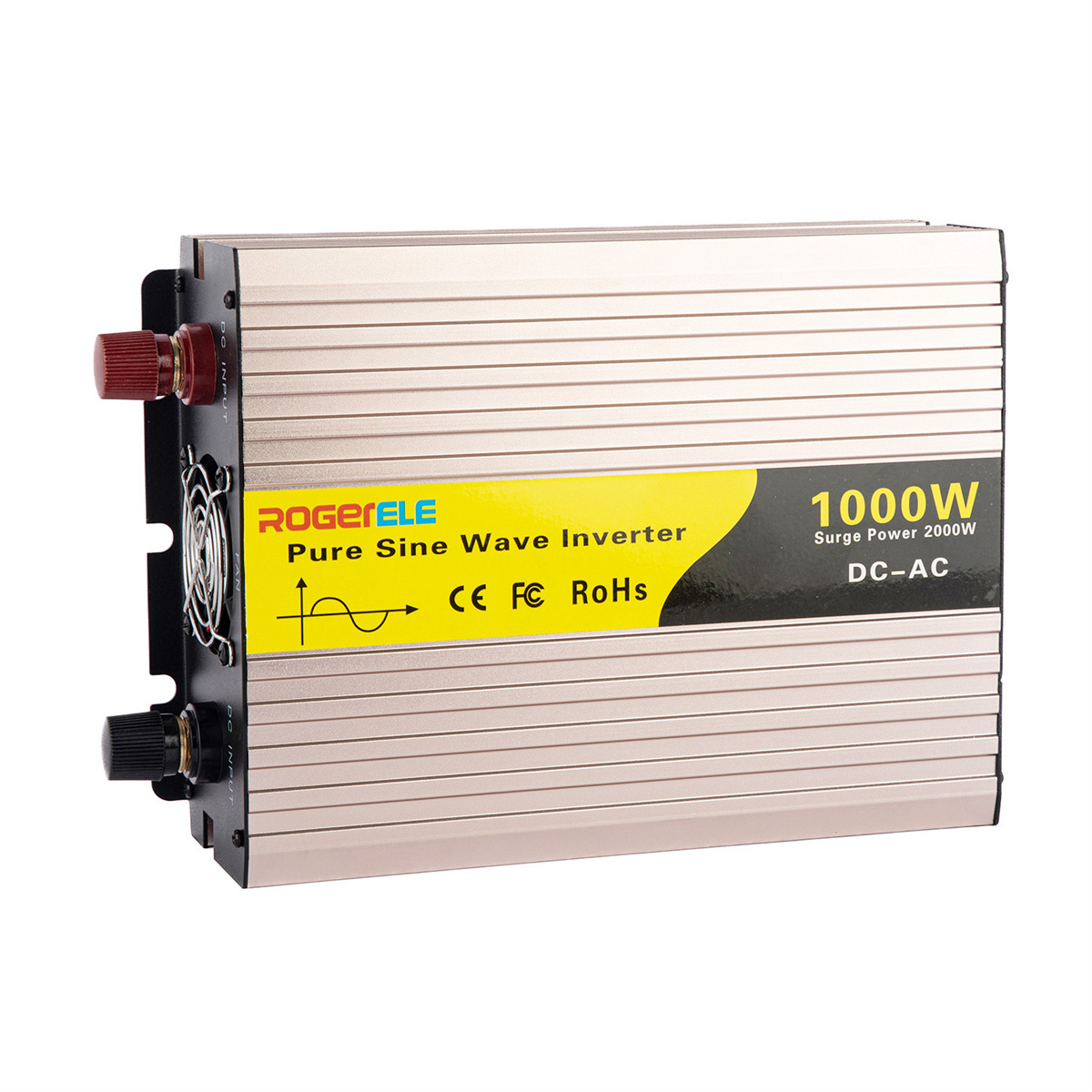 Stay on 12V when the vehicle already has a 12V starting or house system and your continuous AC loads stay in the 300 to 1500W range: laptop and phone charging, a compact fridge, TV, CPAP, coffee maker, or a microwave used alone. Most passenger cars, pickups and light trucks are 12V from the factory, so a matching 12V inverter avoids a second battery chemistry or a DC-DC step-up stage.
The REP1000 pure sine wave inverter is a typical 12V-friendly size: 1000W continuous / 2000W peak, THD below 3% on a linear load, 275 × 180 × 80 mm and 2.5 kg net. It is offered in 12V, 24V and 48V DC versions with 100/110/120V or 220/230/240V AC output. On 12V the listed maximum efficiency is 90%, no-load current is under 0.4A, and the input window is 10 to 15.5V. Low-voltage alarm / cutoff / recovery on 12V are 10.5 ±0.5V / 10 ±0.5V / 12.3 ±0.5V. The 12V and 24V versions include a QC3.0 USB port, and the product page lists a 2-year warranty.
Hardwire, do not use the cigarette lighter
Anything near 1000W at 12V is already about 93A. Accessory sockets and thin factory wiring are not built for that. Hardwire to the battery with a fuse near the positive terminal, keep the DC run short, and size the cable for continuous current plus margin. Our article can my car alternator run a power inverter while driving covers how much alternator capacity is actually free while the engine runs.
When 24V is the better choice
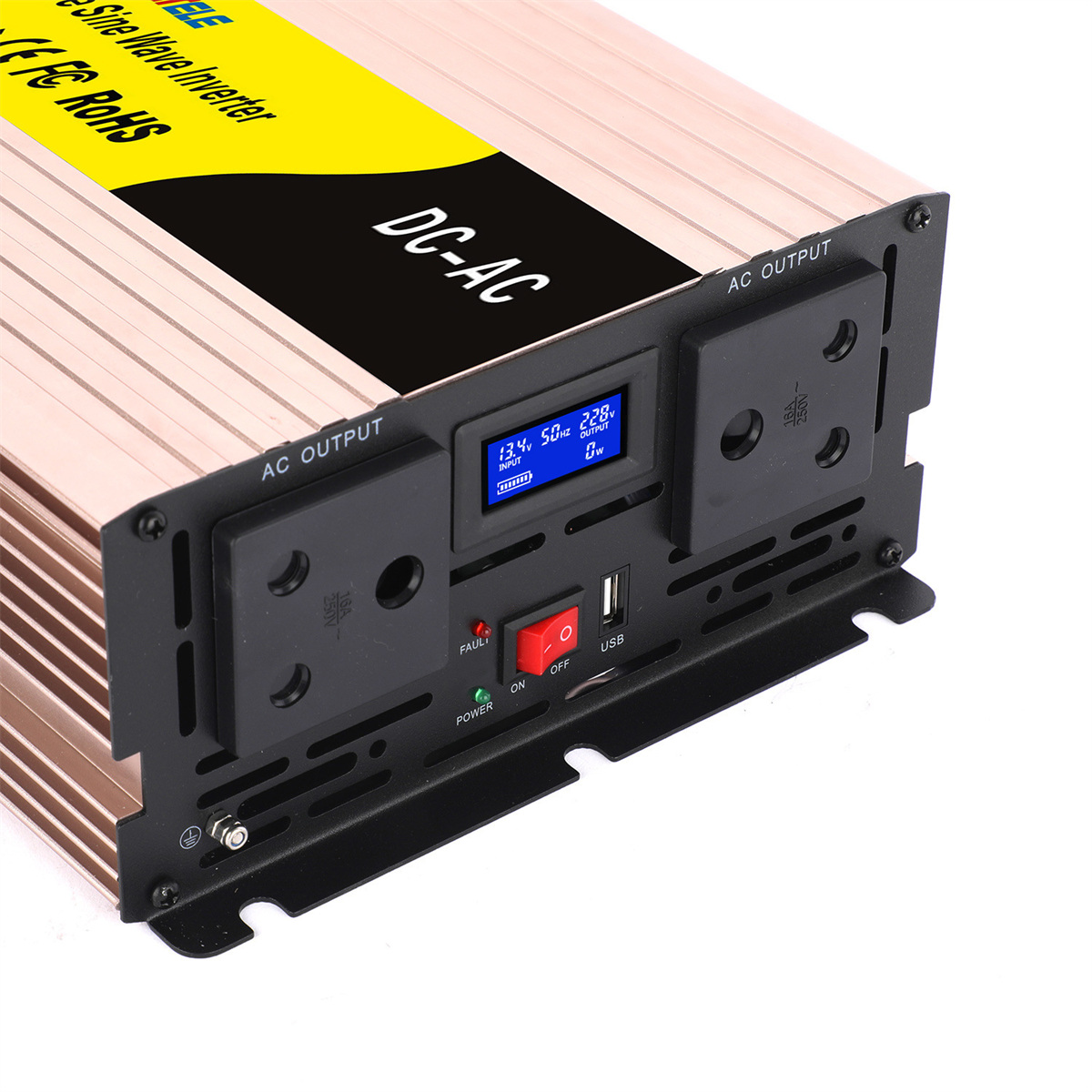 Move to 24V when continuous loads hit 2000W or more, when the inverter must sit several meters from the batteries, or when the truck or RV already uses a 24V house bank. At 2000W, 12V draws about 185A while 24V draws about 93A. That halves copper cross-section for the same voltage drop budget, lowers fuse and bus-bar stress, and keeps the inverter input voltage farther from the low-voltage cutoff under load.
The REP2000 pure sine wave inverter illustrates a 2000W-class unit available in both voltages: 2000W continuous / 4000W peak, pure sine with THD below 3%, 355 × 205 × 95 mm and 3.9 kg net. Listed maximum efficiency is 90% on 12V, 92% on 24V and 95% on 48V. No-load current is under 0.9A (12V), under 0.5A (24V) and under 0.3A (48V). The 24V input range is 20 to 31V, with low-voltage alarm / cutoff / recovery at 21 ±0.5V / 20 ±0.5V / 24 ±0.5V. QC3.0 USB is included on the 12V and 24V versions, with a listed 2-year warranty.
Heavy truck and RV house banks
Many European and commercial trucks are 24V from the factory. Large RV and overland builds often series-pair 12V lithium modules into a 24V house bank so a microwave, induction cooktop or air compressor does not force 4/0 AWG cable everywhere. If your bank is already 24V, order the matching 24V inverter version—do not try to feed a 12V inverter from a 24V pack.
Match inverter DC version to the battery bank
The DC version is fixed at manufacture. A 12V REP unit expects about 10 to 15.5V; a 24V unit expects about 20 to 31V; a 48V unit expects about 40 to 61V. Connecting a 12V inverter to a 24V bank will destroy it. Connecting a 24V inverter to a 12V bank will not start or will sit in low-voltage fault. Count series cells or measure open-circuit voltage before you order, and keep the inverter, BMS and charger on the same nominal voltage.
12V vs 24V comparison for the same AC wattage
| Item | 12V system | 24V system |
|---|---|---|
| 1000W DC current (~90% eff.) | about 93A | about 46A |
| 2000W DC current (~90% eff.) | about 185A | about 93A |
| Cable and fuse size for same watts | Heavier | About half the amps |
| Voltage drop on long runs | Higher risk | Lower for same cable |
| REP1000 no-load current | <0.4A | <0.3A |
| REP2000 no-load current | <0.9A | <0.5A |
| REP1000 max efficiency | 90% | 91% |
| REP2000 max efficiency | 90% | 92% |
| Best fit | Cars, light trucks, ≤1500W loads | 2000W+, long cables, 24V trucks/RVs |
REP1000 vs REP2000 (both voltages available)
| Item | REP1000 | REP2000 |
|---|---|---|
| Continuous / peak | 1000W / 2000W | 2000W / 4000W |
| Waveform / THD (linear load) | Pure sine / <3% | Pure sine / <3% |
| DC versions | 12 / 24 / 48V | 12 / 24 / 48V |
| AC output options | 100/110/120V or 220/230/240V | 100/110/120V or 220/230/240V |
| Size / net weight | 275 × 180 × 80 mm / 2.5 kg | 355 × 205 × 95 mm / 3.9 kg |
| Max efficiency 12 / 24 / 48V | 90% / 91% / 93% | 90% / 92% / 95% |
| No-load 12 / 24 / 48V | <0.4A / <0.3A / <0.2A | <0.9A / <0.5A / <0.3A |
| QC3.0 USB | On 12V and 24V | On 12V and 24V |
| Listed warranty | 2 years | 2 years |
| Best voltage pick | Usually 12V in cars and light trucks | 12V if bank is 12V; 24V if bank is 24V or runs are long |
FAQ
Can I use a 12V inverter on a 24V truck?
No. The DC input range must match the bank. A 12V unit expects about 10 to 15.5V; a 24V bank sits near 24 to 28V and will damage a 12V inverter. Order the 24V version instead.
Is 24V always more efficient?
On the REP1000 and REP2000, listed maximum efficiency is a few points higher on 24V than on 12V (91% vs 90% for REP1000; 92% vs 90% for REP2000). The bigger win is lower cable loss and cooler wiring at high watts.
How do I know if my RV is 12V or 24V?
Check the house battery labels or measure resting voltage with a multimeter. About 12.6 to 13.6V means 12V; about 25 to 27V means 24V. Series-connected 12V modules that read ~25V are a 24V bank.
Does a 2000W load need 24V?
Not always. A short, thick 12V hardwire to a large 12V bank can carry about 185A. Choose 24V when cable runs are long, the bank is already 24V, or you want smaller conductors and less voltage drop.
Which AC output should a US truck or RV use?
Order the 100/110/120V version with US outlets so microwaves, chargers and tools see the expected voltage and frequency for North America.
Conclusion
Pick 12V when the vehicle is already 12V and continuous loads stay under about 1000 to 1500W. Pick 24V for 2000W-class loads, long DC cable runs, or existing 24V truck and RV house banks—the same watts arrive at roughly half the amps. Always match the inverter DC version to the battery voltage, hardwire with a fuse near the battery, and size cable for the real current.
See full specifications on the REP1000 pure sine wave inverter and REP2000 pure sine wave inverter pages. For help matching 12V or 24V to a fleet or OEM build, contact us: email Long@rogerele.com, Tel +86-577-62769701, WhatsApp +86-13587757588.
