
Inverter vs Inverter Charger for RVs and Work Vehicles
Date:2026-09-30 Click:27 Source:ROGERELE
A standalone inverter supplies AC power from a DC battery. An inverter charger adds battery charging from an external AC supply. For an RV builder, service-van outfitter or fleet buyer, the right choice depends on how the vehicle operates between trips and where its batteries are recharged.
This guide focuses on system architecture and purchasing questions. Final equipment selection and installation should be reviewed by a qualified vehicle electrical professional against the exact product manual and applicable local requirements.
Start with the vehicle's daily operating pattern
Write down three operating states before requesting a quotation: driving, parked without external power, and parked with external AC power. List which appliances must run in each state and who will operate the system. A service van returning to a powered depot each evening has different priorities from a vehicle that rarely connects to an external outlet.
- Consider a standalone inverter when the project already has a suitable battery-charging arrangement and the requirement is to supply selected AC loads from the battery.
- Consider an inverter charger when external AC charging is part of the operating plan and the project benefits from combining the two functions in one unit.
- Review separate components when independent replacement, service access or an existing charger is important to the fleet maintenance plan.
Keep charging and AC source transfer separate in the specification
An integrated inverter charger can combine inversion, charging and transfer switching, but the functions and limits must be confirmed for the selected model. Victron's RV shore-power guidance explains these three functions in its own combined units; it does not establish the features of another manufacturer's product. Read the technical background on RV shore power.
Ask the supplier to identify the AC input, AC output, charging function and any internal transfer device on the approved system diagram. Request the transfer rating and interruption time where a transfer function is provided. The word “UPS” alone is insufficient to establish uninterrupted operation for every connected appliance.
A transfer can briefly interrupt power. Victron's transfer-switch operating guidance warns that connected electronics may lose data during the interruption. Test the actual vehicle loads rather than assuming every controller, computer or charger will ride through a change of source.
Compare exact ROGERELE models, not product-family names
ROGERELE lists standalone pure sine wave inverters and inverter-with-charger products. Its REP3000 product page lists a 3000W rated output with 12V, 24V and 48V input variants. Its REPU-2000 inverter-with-charger page lists a 2000W rated output and charging currents of 30A, 20A and 10A for the respective 12V, 24V and 48V variants.
These are different power classes, so they illustrate the two categories rather than an equal-capacity comparison. Confirm the exact input-voltage version, AC output voltage, frequency and charging specification in the quotation. Do not assume one unit supports every listed voltage option.
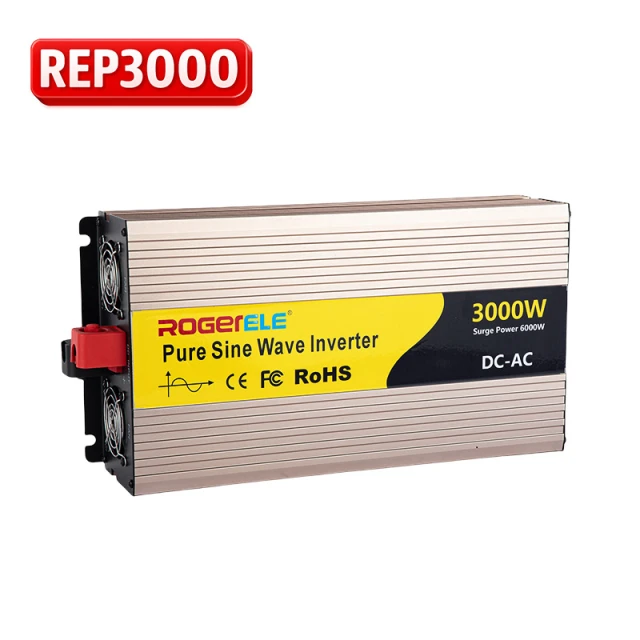
Official ROGERELE REP3000 product image. Confirm the ordered configuration against the current quotation.
Questions to settle before placing an OEM order
- Battery approval: Which battery chemistry and charging settings are supported? Obtain written confirmation for the selected battery and its management system.
- External AC operation: What input range is accepted, what happens when AC is lost, and what happens when it returns?
- Charging budget: What charging current is available, and how will charging be coordinated with the vehicle's other loads and charging sources?
- Protection design: Who approves source isolation, grounding, protective devices and the final vehicle wiring diagram?
- Service behavior: What happens when the unit is switched off or removed for repair, and which loads remain available?
Validate a sample through the complete duty cycle
Include battery-powered operation, external AC connection, loss and restoration of AC, and the intended shutdown procedure in sample acceptance. Record appliance restarts, alarms and operator steps. Agree the expected result for each test before approving production.
For a ROGERELE quotation, provide the vehicle type, battery specification, appliance list, destination market and whether external AC charging is required. This gives the supplier a clear basis for proposing a standalone inverter or inverter charger and confirming the supporting documentation.
