
OEM Inverter Procurement Checklist for Cars, RVs and Work Vehicles
Date:2026-09-30 Click:26 Source:ROGERELE
Before requesting a vehicle inverter quotation, define the electrical requirements, installation constraints and sample acceptance criteria. This checklist helps distributors, RV builders and vehicle upfitters compare supplier proposals on the same basis, from the first inquiry through sample approval.
The scope is low-voltage battery-to-AC inverters for onboard appliances and equipment. It excludes EV traction inverters and connections to a hybrid or electric vehicle's high-voltage battery.
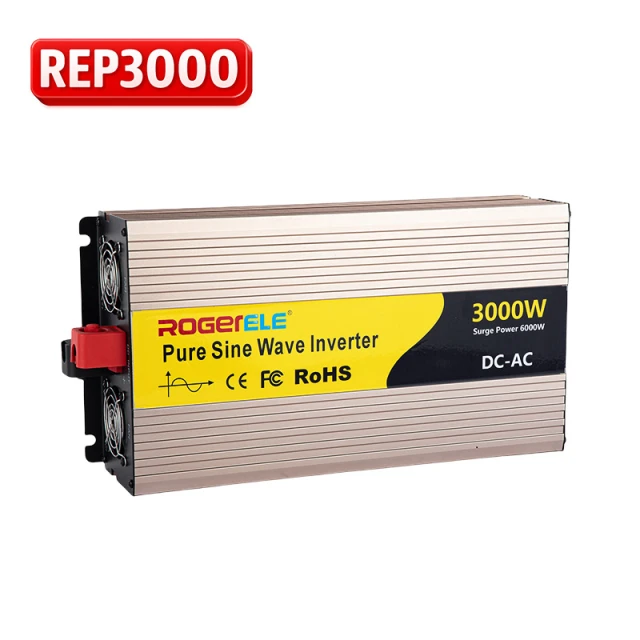
ROGERELE REP3000 product image. Confirm the exact input voltage, AC output and configuration before ordering.
1. Describe the application before naming a wattage
Tell the supplier who will use the inverter, what equipment it will power and whether operation is occasional or continuous. Include devices used together, starting demand, daily operating hours and any equipment-manufacturer compatibility requirements. A work-van tool charger and an RV compressor can present different demands even when their running watts look similar.
For the calculation stage, see our car and truck inverter sizing guide. In the quotation request, record the resulting requirements rather than asking suppliers to infer them from a vehicle description.
2. Specify DC input and market-specific AC output
State the nominal battery-bank voltage and expected operating range, including charging and discharge conditions. Separately specify AC output voltage, frequency and outlet type for the destination market. An outlet adapter does not convert voltage or frequency. Samlex's inverter fundamentals guide provides background on these electrical distinctions.
Use an exact model and configuration in supplier comparisons. For example, the ROGERELE REP3000 product page lists separate input-voltage versions and AC output options. That makes the model suffix and ordered configuration important; a shared 3000 W rating does not establish compatibility with every vehicle or appliance.
3. Ask how power ratings were established
Request continuous output under the expected installation conditions, plus surge magnitude and duration. Ask whether temperature or other conditions reduce available continuous power. A headline peak rating without a duration is insufficient to judge compressor or motor starting.
Where documents use both watts and volt-amperes, keep those values separate. Victron's Inverter Compact manual illustrates separate VA, watt, temperature-dependent and peak ratings. Request comparable clarity for the actual model being quoted, rather than applying another manufacturer's figures.
4. Define waveform, battery and charging requirements
Request the output waveform specification and confirm compatibility with representative customer equipment. Pure sine wave is a sensible starting point for mixed loads, but approval should follow the equipment requirements and sample evaluation. Samlex's inverter reference guide discusses waveform selection across load categories.
Include the battery chemistry, usable energy target and permitted continuous and surge current. Confirm battery-management-system limits where applicable. For parked operation, review our auxiliary battery planning guide with the installer so the starting battery's role is clear.
If shore power is involved, specify whether battery charging or automatic transfer is required. These functions must be confirmed individually; they are not included in every inverter. Victron's Multi description illustrates an inverter-charger with combined functions, not a specification for other products.
5. Include mechanical and installation constraints
Provide mounting-space dimensions, orientation constraints, ventilation clearance, ambient conditions and service-access needs. Ask about terminal arrangements, supplied accessories and any required remote controls. Agree which items are included and which the vehicle integrator must provide.
Our vehicle inverter installation guide outlines topics to discuss. Final wiring, protection and grounding must follow the exact product manuals and applicable local requirements, with a qualified installer. Victron's installation guidance is another reference for siting and connection precautions. Never feed inverter output into a wall socket or another AC source.
6. Send a quotation-ready specification
- Destination market, intended users and vehicle application
- DC operating range; AC voltage, frequency and outlet requirements
- Load list, continuous demand, startup demand and operating schedule
- Battery/BMS limits, runtime target and charging or transfer requirements
- Mounting envelope, cooling conditions, interfaces and accessories
- Complete inverter or PCBA solution, sample quantity and forecast volume
- Required manuals, drawings and model-specific test or certification documents
- Requested lead time, packaging, labeling and warranty information
Ask the supplier to identify any unmet requirement or proposed alternative explicitly. Verify relevant compliance evidence for the exact configuration and intended market; a logo or a document for another model is insufficient.
7. Agree sample acceptance before production approval
Define the test plan and pass criteria before ordering evaluation samples. Check representative loads, startup behavior, output under agreed conditions, idle consumption, physical fit and interfaces. Have appropriately qualified personnel handle electrical testing.
Record the sample's model, configuration and revision, test conditions and results. Resolve discrepancies with the supplier before production approval, and agree how later component or specification changes will be communicated. Sending this checklist with an OEM inquiry to ROGERELE gives both buyer and factory a clearer basis for model selection and sample evaluation.
