
DC to AC Converter: How a 12V Car Inverter Makes 120V
Date:2026-10-30 Click:22 Source:Rogerele
Quick answer: A DC to AC converter for a car is a power inverter. It takes 12V (or 24V) direct current from the vehicle battery and turns it into 120V, 60Hz alternating current like a wall outlet. Size it at about 1.25 times your total running watts, choose pure sine output for electronics, and expect the battery to supply roughly watts divided by 10.8 in amps at 12V: about 93A for 1000W and about 185A for 2000W.
Most people search for a DC to AC converter when they want to run a laptop, a CPAP, a coffee maker or power tools from a car, pickup or work truck. The vehicle only has low-voltage DC, and household appliances need 120V AC. The device that bridges the two is the same thing sold as a 12V inverter, an auto power inverter or a DC to AC power inverter. This guide explains how it converts the power, how to size one, what current it pulls from the battery, and how a 1000W and a 2000W model compare.
How does a DC to AC inverter transform DC to AC?
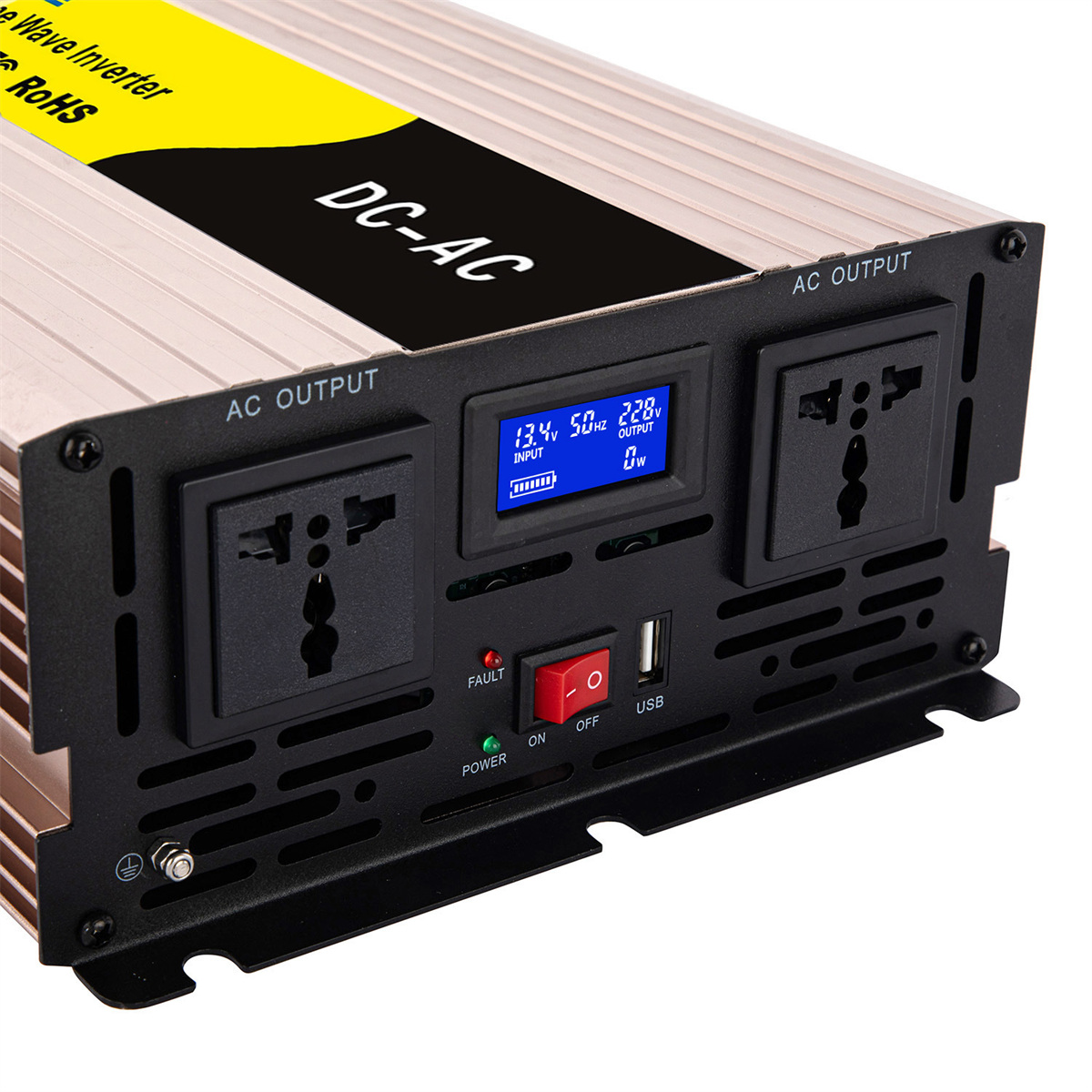 Direct current flows one way at a steady voltage, about 12.6V from a rested lead-acid battery or about 13.2V from LiFePO4. Alternating current reverses direction 60 times per second in North America (50 times in many other regions) and swings to a peak of about 170V for a 120V supply. To transform DC to AC, a typical inverter works in three steps. First, it raises the low battery voltage to a high DC voltage. Second, power transistors switch that high voltage on and off in a fast, controlled pattern called pulse-width modulation. Third, an output filter smooths the pattern into a clean sine wave. The front display on many models, like the one shown here, reports input voltage and output load so you can see what the battery is doing.
The quality of that last step decides the waveform. A pure sine wave output closely matches grid power, which matters for laptop chargers, CPAP machines, TVs, microwaves and motor loads. Rogerele REP models list total harmonic distortion under 3% on a linear load.
How to convert DC to AC safely in a vehicle
Every watt on the AC side comes out of the battery as current on the DC side. With about 90% efficiency, a 12V inverter draws about 1A of battery current for every 10.8W of load. That is why the wiring, not the inverter, is usually the weak point:
- A dash or cigarette lighter socket is usually fused at 10 to 15A, so it can only feed about 120 to 180W.
- Anything above roughly 150W should be wired directly to the battery with short, heavy cables and a fuse close to the battery.
- Match the inverter input voltage to the vehicle: 12V for cars and most pickups, 24V for many heavy trucks and buses.
- Run heavy loads with the engine running or from an auxiliary battery, so the starting battery is not drained.
For cable gauge and fuse sizing step by step, see how to install a car power inverter: wire size and fuse.
12V inverter sizing: watts, surge and battery amps
Add up the running watts of everything you will use at the same time, then multiply by 1.25 so the inverter is not working at its limit. Motors and compressors also need a short start surge of two to three times their running watts. The table below shows typical 120V loads and the battery current they create through a 12V DC to AC power inverter at about 90% efficiency.
| Load (120V, typical) | Running watts | 12V battery current (approx.) | Suggested inverter |
|---|---|---|---|
| Phone, tablet and laptop charging | 50 to 130W | 5 to 12A | 300W or larger |
| CPAP without heated humidifier | 30 to 60W | 3 to 6A | 300W or larger |
| Cordless tool battery chargers (two) | 200 to 400W | 19 to 37A | 1000W |
| Compact drip coffee maker | 600 to 800W | 56 to 74A | 1000W |
| 700W microwave (input power) | 1,100 to 1,200W | 102 to 111A | 2000W |
| Electric kettle or hair dryer | 1,200 to 1,500W | 111 to 139A | 2000W |
| Circular saw, 7-1/4 in | 1,200 to 1,400W plus start surge | 111 to 130A | 2000W |
Runtime follows the same math. A 100Ah 12V LiFePO4 battery stores about 1,280Wh. At a 600W load it gives a little under 2 hours, and at 100W of laptop and CPAP it lasts about 11 hours. A car starting battery should only be used for light loads with the engine off.
1000W DC to AC power inverter for cars and pickups
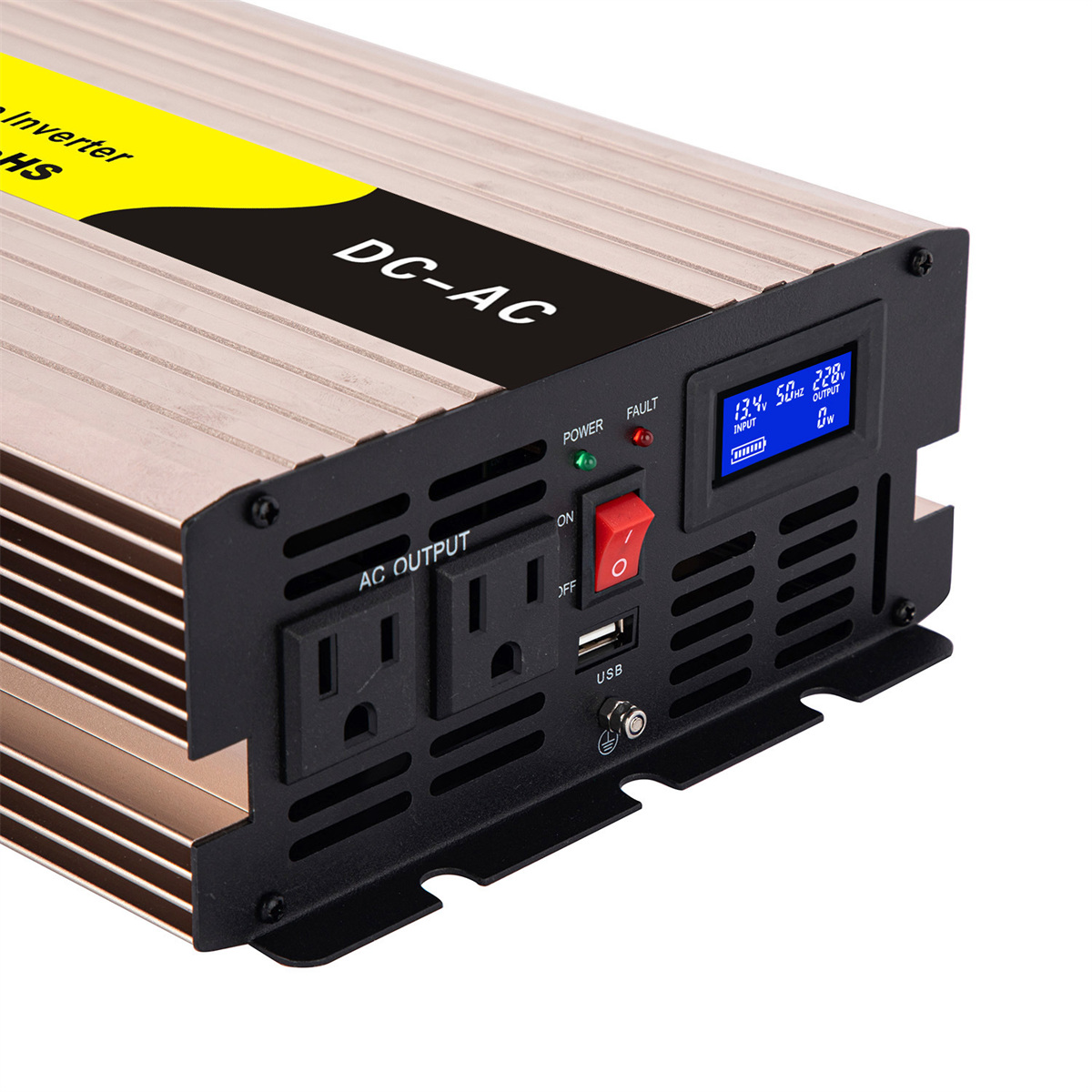 The REP1000 pure sine wave inverter is the practical size for a car or small pickup. The 12V version (REP1000-121) is rated 1000W continuous with a 2000W peak, accepts 10 to 15.5V DC, and outputs 100, 110 or 120VAC at 50 or 60Hz. Maximum efficiency is 90% on 12V, and no-load current is under 0.4A. It covers laptops, a CPAP, tool chargers, a blender and a compact coffee maker, and it weighs 2.5 kg, so it fits under a seat or behind a rear panel.
2000W DC to AC converter for trucks and work vans
For a microwave, a kettle or a saw, step up to the REP2000 pure sine wave inverter. It is rated 2000W continuous with a 4000W peak (peak duration is not specified), with THD under 3% on a linear load. It is offered in 12V (10 to 15.5V), 24V (20 to 31V) and 48V (40 to 61V) input versions, with 100/110/120V or 220/230/240V output at 50 or 60Hz. Maximum efficiency is 90% on 12V and 92% on 24V. At full load the 12V version draws about 185A, so a 24V truck system, which halves the current, is a strong fit.
REP1000 vs REP2000 specification comparison
| Specification | REP1000 (12V version) | REP2000 (12V version) |
|---|---|---|
| Rated / peak output | 1000W / 2000W | 2000W / 4000W |
| Waveform / THD | Pure sine, <3% linear load | Pure sine, <3% linear load |
| DC input range | 10 to 15.5V | 10 to 15.5V |
| Model code / AC output | REP1000-121: 100/110/120V, 50 or 60Hz | REP2000-121: 100/110/120V, 50 or 60Hz (220/230/240V as REP2000-122) |
| Max efficiency (12V) | 90% | 90% |
| No-load current (12V) | <0.4A | <0.9A |
| Low-voltage alarm / cutoff (12V) | 10.5V / 10V | 10.5V / 10V |
| Battery current at full load (approx.) | about 93A | about 185A |
| Size / net weight | 275 × 180 × 80 mm / 2.5 kg | 355 × 205 × 95 mm / 3.9 kg |
| Best vehicle use | Car, SUV, small pickup | Full-size pickup, work van, 24V truck |
FAQ
Is a DC to AC converter the same as an inverter?
Yes. In vehicles and off-grid systems, a DC to AC converter and a DC to AC inverter are the same device: it changes battery DC into household AC.
Does an inverter charge the battery?
No. A standard DC to AC inverter such as the REP2000 does not include a battery charger or solar controller. The alternator, a charger or a solar controller recharges the battery.
How much power is lost in the conversion?
At about 90% efficiency on 12V, roughly 10% becomes heat. A 1000W load takes about 1,110W from the battery.
Can one inverter work on 12V and 24V?
No. 12V, 24V and 48V versions are separate models with different input ranges. Choose the one that matches your battery.
Conclusion
A DC to AC converter for a car or truck is simply a power inverter that turns battery DC into 120V AC. Add up your running watts, multiply by 1.25, plan for about 93A per 1000W at 12V, and wire anything above about 150W directly to the battery with a fuse. A 1000W model covers electronics and small kitchen loads, while 2000W handles a microwave, kettle or saw. Compare the REP2000 pure sine wave inverter and the REP1000 for your vehicle. For quotes, OEM options or 24V and 48V versions from Wenzhou Rogerele Electronic Technology Co., Ltd., contact us.
