
How to Install a Car, Truck or RV Power Inverter: Wire Size, Fuse and Grounding
Date:2026-09-29 Click:27 Source:Rogerele
Quick answer: Install a pure sine wave inverter as close to the battery as practical, on a dry, cool surface with clear space around the fans. Run copper cable sized for the DC current (a 12V inverter draws about twice the current of a 24V unit at the same wattage), and put a DC-rated fuse or breaker on the positive cable, close to the battery — not at the inverter. Connect positive to positive and negative to negative, ground the case to the vehicle chassis, and do not use the cigarette-lighter socket for anything beyond a very small load.
This page is the wiring and mounting guide. To choose 12V or 24V and a wattage first, see what size inverter for a car or truck. For why the output should be pure sine wave rather than modified sine wave, see pure sine vs modified sine wave.
What should I check before I connect anything?
Rogerele REP pure sine wave inverters come in DC12V, DC24V and DC48V versions. A 12V unit on a 24V truck battery will be damaged. On the 1000W, 2000W and 3000W pages the input ranges are 10–15.5V, 20–31V and 40–61V. Models ending -121 / -241 / -481 output 100V, 110V or 120VAC; models ending -122 / -242 / -482 output 220V, 230V or 240VAC, at 50Hz or 60Hz. Order the pair your appliances use.
Switch the inverter off and disconnect the battery negative before you crimp anything. Reconnect it last. These pages describe reverse-polarity protection as fuse burn-out, so swapped cables can blow that fuse and may still damage the inverter.
What cable and fuse size does a car inverter need?
DC current is roughly AC watts ÷ battery volts ÷ efficiency. The table uses about 90%, which is the 12V efficiency listed on these pages (24V and 48V models are listed up to 95%, so they draw a little less). Fuses are about 125% of that current. Cable is a starting point for a short copper run, about 1–1.5 m (3–5 ft) one way. A longer run needs thicker cable to keep voltage drop near 3%. Check the final size on the ampacity chart for your cable's insulation.
| Inverter | 12V current | 12V fuse / cable | 24V current | 24V fuse / cable |
|---|---|---|---|---|
| 500W | ≈ 46A | 60A / 6–8 AWG | ≈ 23A | 30A / 10 AWG |
| 1000W | ≈ 93A | 125A / 2–4 AWG | ≈ 46A | 60A / 6–8 AWG |
| 2000W | ≈ 185A | 250A / 2/0 AWG | ≈ 93A | 125A / 2–4 AWG |
| 3000W | ≈ 278A | 350A / 4/0 AWG | ≈ 139A | 175A / 1–2 AWG |
Use the same gauge on both cables. At 48V the current is about half the 24V number again. For 6000W, see the 6000W truck and RV guide. These product pages do not publish a cable chart, so the table is general practice, not a factory specification.
Where does the fuse or breaker go?
Put one DC-rated fuse or breaker (ANL, Class T, MEGA, or a DC breaker of that amp rating) on the positive cable, as close to the battery post as practical. Many vehicle and marine installers aim for about 18 inches (450 mm). The fuse protects the cable from a short to the chassis. A fuse only at the inverter leaves that run unprotected. Do not fuse the negative cable instead.
How do I connect the inverter to the battery?
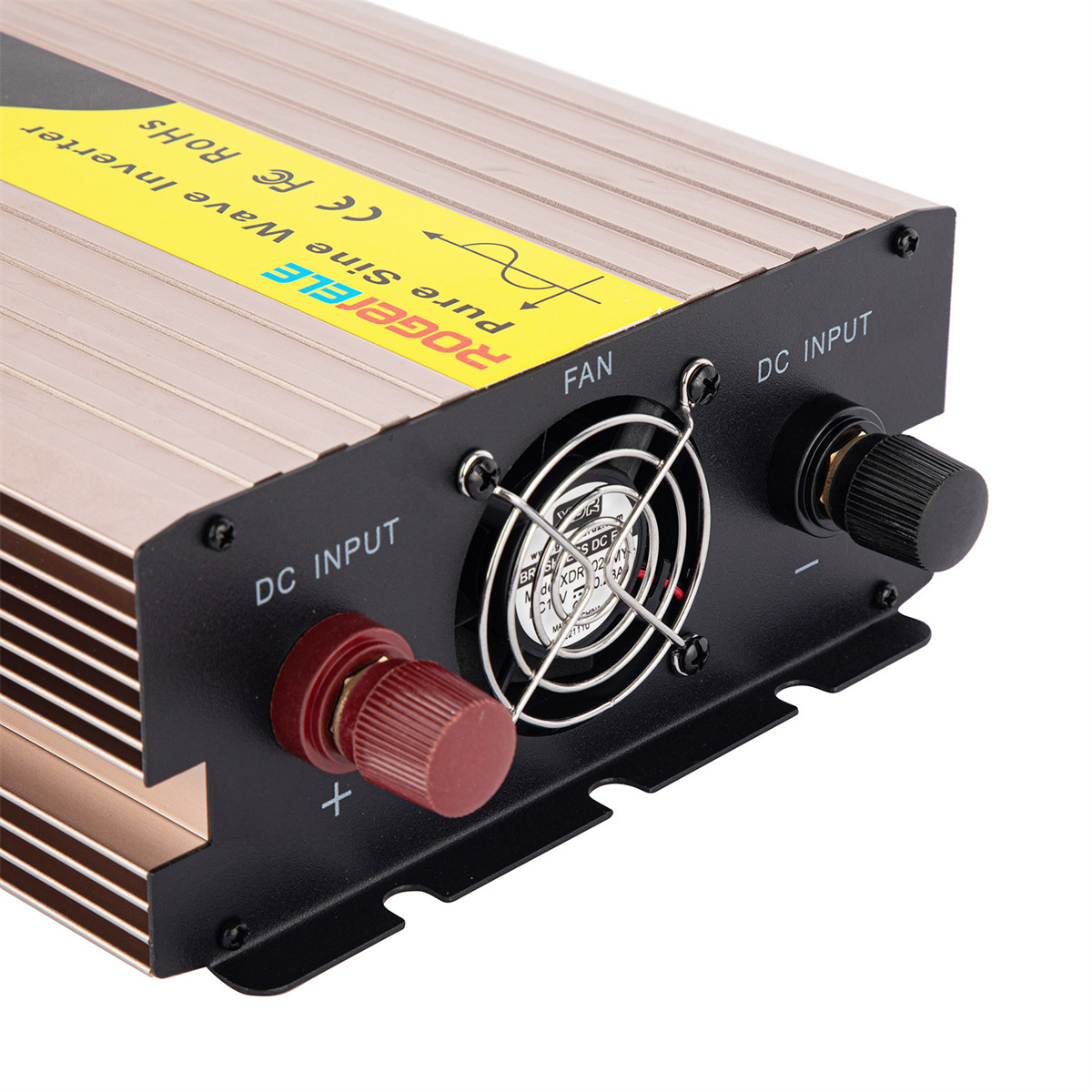
- Crimp ring terminals that fit the stud. A loose strand under the nut will heat up.
- Positive runs from the battery, through the fuse, to the inverter positive. Negative runs from the battery negative post straight to the inverter negative. Do not return high current through the vehicle chassis.
- Keep the run short, clear of sharp edges and the exhaust, and use a grommet through sheet metal.
- Above a few hundred watts, use an auxiliary or house battery. A fridge left running will flatten a starting battery.
A cigarette-lighter socket is typically fused around 10–15A (about 100–150W at 12V). It cannot feed the inverters in the table.
How should the inverter be grounded?
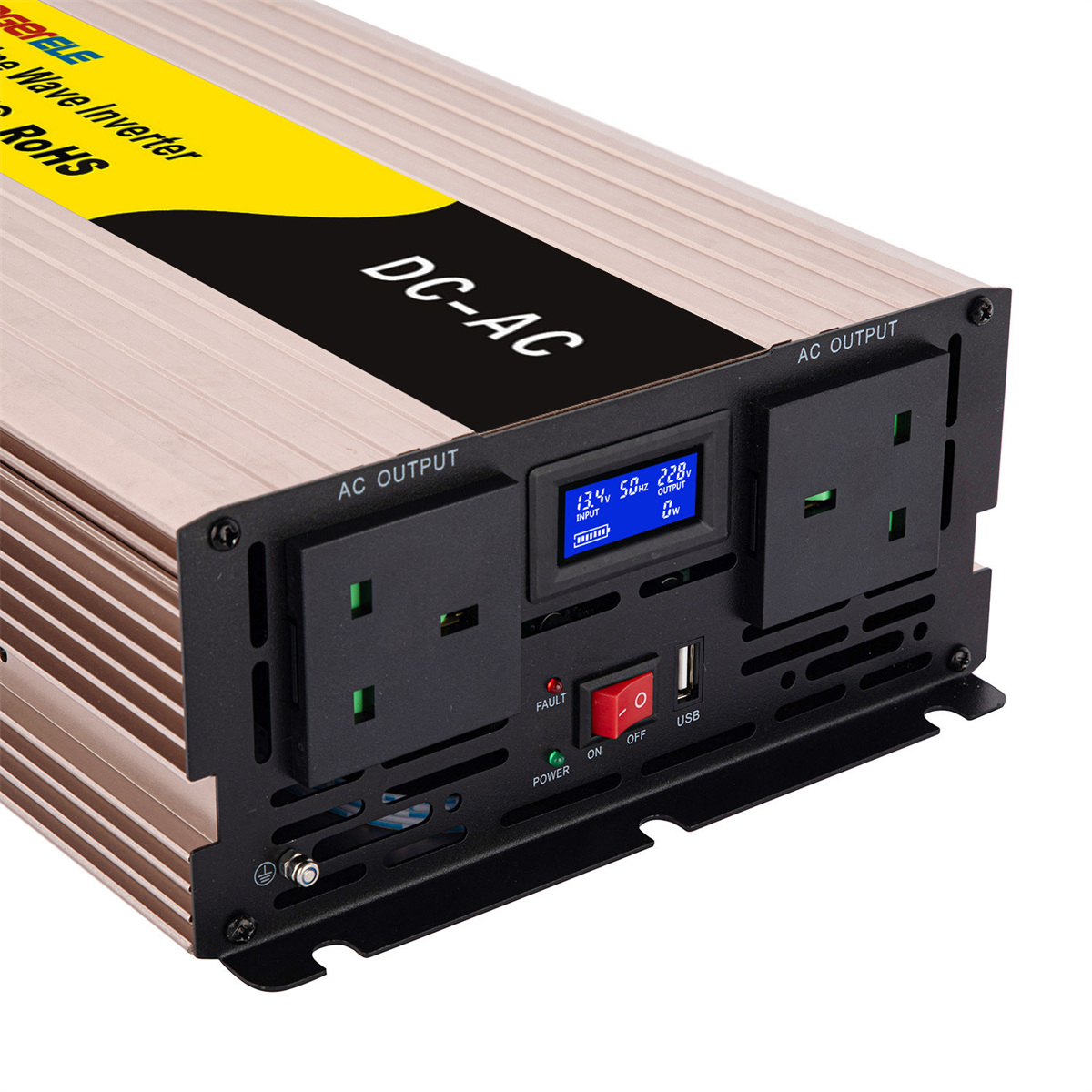
DC negative carries load current back to the battery. The chassis ground is separate: it bonds the metal case to the vehicle body so an internal fault blows the fuse instead of leaving the case live. If the unit has a chassis-ground stud, run a short cable from it to clean bare metal on the frame. If you cannot find a separate stud, do not treat the DC negative as the chassis ground — check the manual or ask Rogerele. Use plugs that match the AC voltage you ordered. In a damp bay, add GFCI protection. If the vehicle also has shore power, the two sources must never feed the same circuit at once; use a transfer switch.
Where should I mount a car or RV inverter?
The REP1000, REP2000 and REP3000 pages list a working temperature of −10°C to +50°C and intelligent air cooling, so location matters:
- Cool and ventilated. Not in the engine bay, on the exhaust tunnel, or in a closed cabinet in the sun. Leave space in front of the fans. Do not cover the unit with bedding or tools.
- Dry. Keep it out of wheel spray, bilge water and a battery box that vents hydrogen from flooded lead-acid cells.
- Solid and reachable. Bolt it down. The 1000W model is about 2.5 kg and the 3000W about 4.95 kg; a loose terminal cracks under vibration. You should be able to see the display and reach the switch, or fit a disconnect (below).
Can I add a remote switch?
The REP pages linked here do not list a remote on/off or a remote port. Do not assume one is in the box. Ask Rogerele whether that model has a remote kit, or fit a DC disconnect rated for the current in the table where the driver can reach it. The switch must open the positive cable. It does not replace the fuse at the battery unless the disconnect itself is a correctly rated breaker mounted there.
Switch the inverter off when it is idle. The pages list a no-load draw even with nothing plugged in: under 0.4A at 12V on the 1000W models and under 0.9A at 12V on the 2000W models. Left on for days, that flattens a battery.
FAQ
Can I plug a 1000W inverter into the cigarette lighter?
No. That socket cannot supply the roughly 90A a 12V 1000W inverter draws. Wire it to the battery with a fuse on the positive cable.
Should the fuse be next to the inverter or next to the battery?
Next to the battery, on the positive cable. A fuse at the inverter does not protect the cable if it shorts to the chassis along the way.
Why is 24V cable thinner than 12V cable?
The same watts at twice the voltage need about half the current. A 2000W inverter is about 185A at 12V and about 93A at 24V, so a short 24V run can use about 2–4 AWG instead of 2/0 AWG.
Can I mount the inverter in the engine compartment?
No. These models are rated to about +50°C and need moving air. Engine heat, water and oil mist are a bad match. Use the cab, a dry locker or a ventilated RV compartment.
Does Rogerele publish a remote switch for the REP series?
Not on the REP1000, REP2000 or REP3000 pages. Confirm with the factory if you need a cab switch, or install a DC disconnect rated for the battery current. For a custom cable kit or a fleet install, use the contact page.
