
How Long Will a Battery Run an Inverter? Runtime Formula and Examples
Date:2026-09-29 Click:40
Quick answer: Estimate inverter runtime with Runtime (hours) ≈ Battery Ah × Battery voltage × usable DoD × inverter efficiency ÷ average AC load watts. A 12V 100Ah LiFePO4 bank at 80% usable capacity, a 90% efficient pure sine wave inverter and a 100W continuous load gives about 8.6 hours. Use your average load (not peak), account for the inverter's unload (no-load) current, and stop before the battery's low-voltage cutoff.
How do you calculate how long a battery will run an inverter?
Battery amp-hours alone do not answer the question. You need energy in watt-hours, how much of that energy you are willing to use, how efficient the inverter is, and how many watts your AC loads actually draw on average.
Use this planning formula:
Runtime (h) ≈ (Battery Ah × V × DoD × η) ÷ W
- Battery Ah — the nameplate amp-hour rating of the bank.
- V — nominal battery voltage (12V, 24V or 48V).
- DoD — usable depth of discharge as a decimal (for daily cycling, many planners use about 0.5 for lead-acid and about 0.8 for LiFePO4; always follow your battery datasheet).
- η — inverter efficiency as a decimal (use the published maximum efficiency for a first estimate, or about 0.90 if you want a conservative figure).
- W — average AC load in watts while the inverter is on.
Example: 12V × 100Ah = 1,200Wh nameplate. At 80% usable and 90% inverter efficiency you have 1,200 × 0.8 × 0.9 = 864Wh available to the AC load. At 100W average, runtime ≈ 864 ÷ 100 = 8.6 hours. At 200W average, it is about 4.3 hours.
Why amp-hours alone mislead: convert to watt-hours first
A "100Ah battery" stores very different energy at different voltages:
| Bank | Nameplate energy | Usable at 80% DoD | Usable at 50% DoD |
|---|---|---|---|
| 12V 100Ah | 1,200Wh | 960Wh | 600Wh |
| 24V 100Ah | 2,400Wh | 1,920Wh | 1,200Wh |
| 48V 100Ah | 4,800Wh | 3,840Wh | 2,400Wh |
Always multiply Ah × V before you divide by load watts. The same 100Ah pack at 48V holds four times the energy of a 12V 100Ah pack.
How does inverter efficiency change battery runtime?
An inverter converts DC battery power to AC. Losses show up as heat, so only part of the battery energy reaches your appliances. Rogerele publishes maximum efficiency on each product page. For example:
| Model | Rated / peak | Max. efficiency (12V / 24V / 48V) |
|---|---|---|
| REPU-500 | 500W / 1000W | 90% / 90% / 92% |
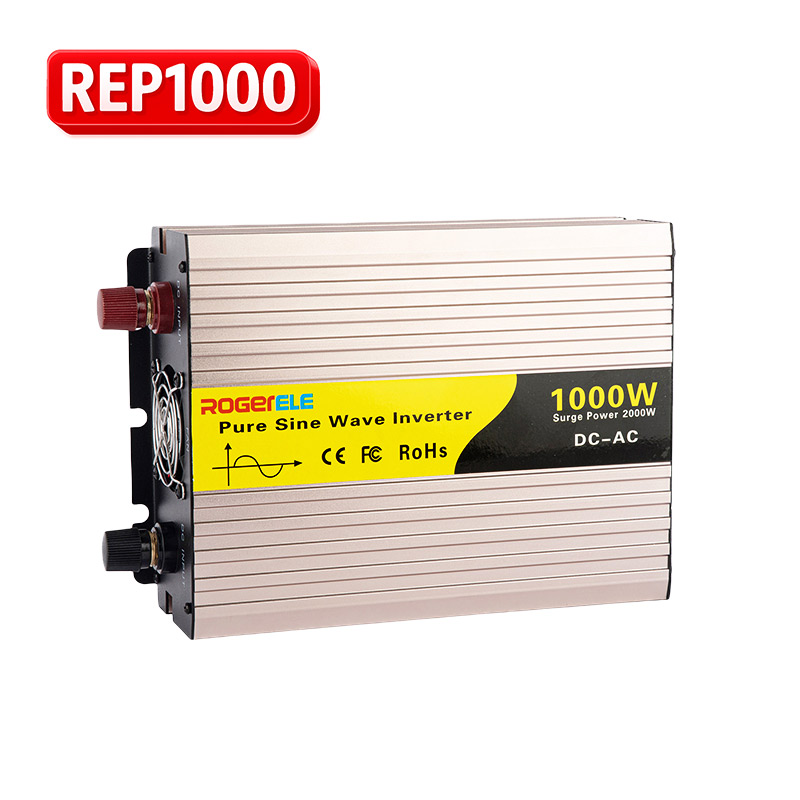
| REP1000 | 1000W / 2000W | 90% / 91% / 93% |
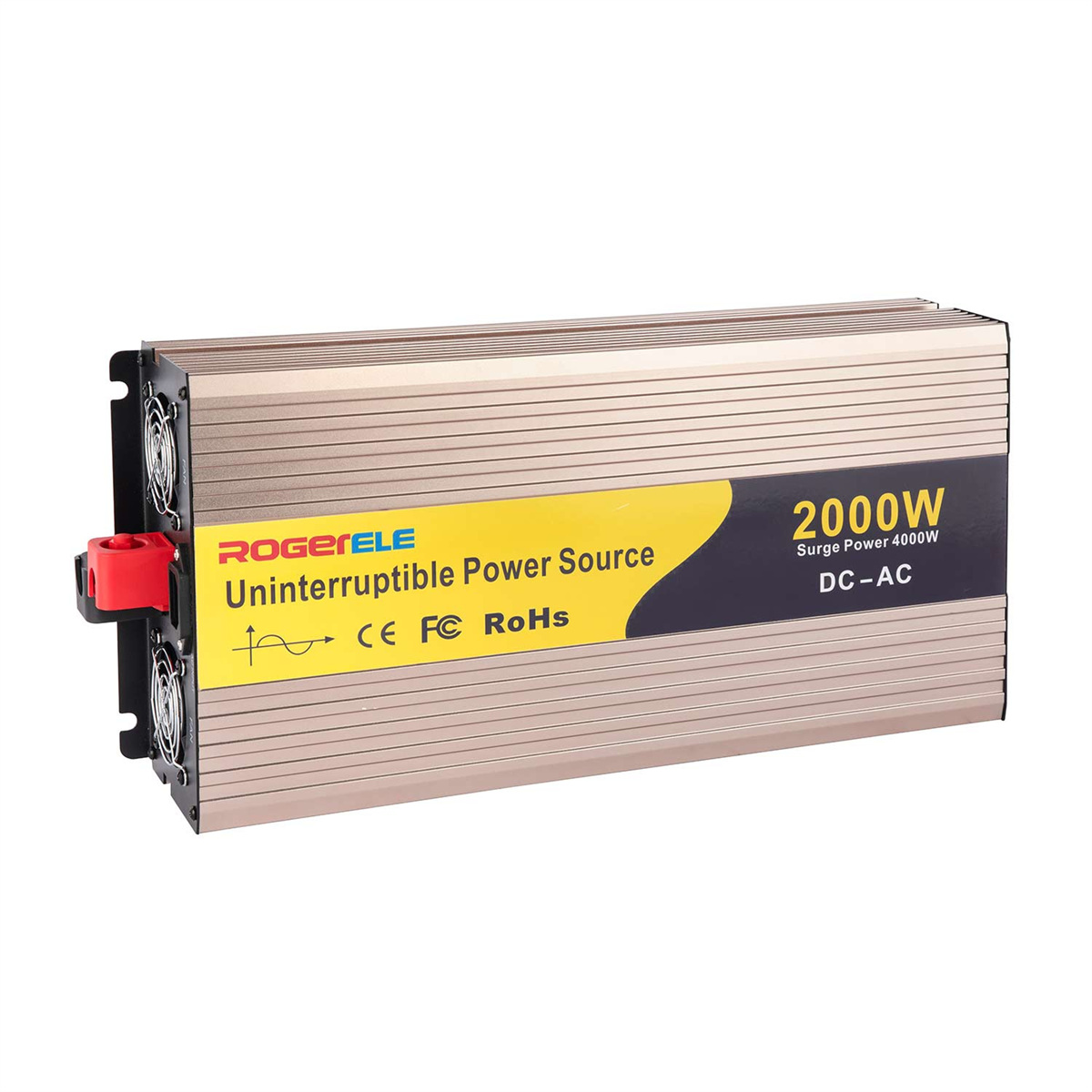
| REPU-2000 | 2000W / 4000W | 90% / 92% / 95% |
| REPU-3000 | 3000W / 6000W | 90% / 92% / 95% |
These are maximum efficiencies from the product pages; real efficiency varies with load level, so overnight planning often uses about 90%. All models above are pure sine wave with THD <3% on a linear load.
How much does inverter unload (no-load) current shorten runtime?
Even with no AC load plugged in, an inverter still draws a small DC current. Rogerele lists this as Unload current less than on the product pages:
| Model | Unload current (12V / 24V / 48V) | Approx. idle watts at 12V |
|---|---|---|
| REP300 | <0.3A / 0.2A / 0.2A | ~3.6W |
| REP1000 | <0.4A / 0.3A / 0.2A | ~4.8W |
| REP2000 / REPU-2000 | <0.9A / 0.5A / 0.3A | ~10.8W |
| REPU-3000 | <1A / 0.7A / 0.4A | ~12W |
Idle watts ≈ unload amps × battery volts. A more detailed estimate is Runtime (h) ≈ usable Wh ÷ ((AC load ÷ η) + idle watts). Example: 12V 100Ah LiFePO4 at 80% usable = 960Wh; 100W AC at 90% efficiency plus ~11W idle on a REPU-2000 is about 122W from the battery → 960 ÷ 122 ≈ 7.9 hours (shorter than the simple 8.6-hour estimate).
Runtime examples for common loads
Simple formula at 90% inverter efficiency. LiFePO4 rows use 80% DoD; lead-acid uses 50%. Planning estimates only.
| Battery | Chemistry (DoD) | Average AC load | Approx. runtime |
|---|---|---|---|
| 12V 100Ah | LiFePO4 (80%) | 50W (router + lights) | ~17 hours |
| 12V 100Ah | LiFePO4 (80%) | 100W (laptop + Wi-Fi + lights) | ~8.6 hours |
| 12V 100Ah | Lead-acid (50%) | 100W | ~5.4 hours |
| 12V 200Ah | LiFePO4 (80%) | 150W (small fridge cycling) | ~11.5 hours |
| 24V 100Ah | LiFePO4 (80%) | 300W | ~5.8 hours |
| 48V 100Ah | LiFePO4 (80%) | 500W | ~6.9 hours |
For a fridge, use average watts over an hour (compressor cycling), not nameplate watts alone. Start-up surge is covered by peak rating, not by the runtime formula.
When does the inverter cut off and protect the battery?
Runtime ends when the battery voltage reaches the inverter's low-voltage protection threshold, or when your battery BMS disconnects first. On Rogerele REPU and REP models, typical 12V thresholds from the product pages are:
- Low voltage alarm: about 10.5V (21V on 24V, 42V on 48V)
- Low voltage protection (shutdown): about 10V (20V on 24V, 40V on 48V)
- Over voltage protection: about 15.5V (31V on 24V, 61V on 48V)
Do not plan on 100% of a lead-acid bank: the inverter shuts down before the last amp-hours are useful, and deep discharge shortens life. Match input range to the bank (Rogerele 12V models typically 10–15.5V, 24V 20–31V, 48V 40–61V).
Which Rogerele inverter fits car, home backup or solar storage?
- Car, van or truck: pure sine wave inverters such as 300W, 1000W and 2000W. Match continuous and peak ratings to your loads; see the car and truck sizing guide.
- Home backup with grid charging: an inverter with charger (UPS). The REPU-2000 and REPU-3000 charge at 30A/20A/10A on 12V/24V/48V (2000W/4000W peak and 3000W/6000W peak respectively).
- Solar hybrid: solar hybrid inverters and the GA series. Also see UPS vs hybrid vs off-grid and home battery backup sizing.
Rogerele (Wenzhou Rogerele Electronic Technology Co., Ltd.) is a source factory for these pure sine wave inverters. For OEM or customized DC input, use the contact page.
FAQ: battery runtime with an inverter
How long will a 12V 100Ah battery run a 1000W inverter?
The inverter rating is the ceiling, not the load. At 1000W continuous, 90% efficiency and 80% DoD on 12V 100Ah LiFePO4 (~864Wh usable), runtime is under one hour. At a more realistic 200W average load, about 4.3 hours.
Does a higher-wattage inverter drain the battery faster?
Not by itself. A larger inverter only draws more if you run larger loads. It may have a slightly higher unload current when idle, so for light overnight loads a smaller pure sine model can leave more energy in the battery.
Should I use lead-acid or LiFePO4 for longer runtime?
For the same nameplate Ah, LiFePO4 usually delivers longer usable runtime because you can safely use a deeper DoD (often around 80% vs about 50% for daily lead-acid use). Always follow the battery manufacturer's limits and charge profile.
Why is my real runtime shorter than the formula?
Common causes: you used peak watts instead of average watts; you ignored inverter efficiency or unload current; temperature or age reduced battery capacity; cable voltage drop triggered low-voltage shutdown early; or a BMS cut off before the inverter's own LVD.
Can I leave the inverter on with no load overnight?
Yes, but unload current still drains the battery. On a REPU-2000 at 12V, less than 0.9A is roughly 11W — about 130Wh over 12 hours. Switch off when you do not need AC, or size the bank with idle draw included.
Where can I buy or OEM a pure sine wave inverter for battery systems?
See Rogerele's pure sine wave inverters and UPS inverters, or contact the factory for OEM options.
