
UPS vs Hybrid vs Off-Grid Inverter for Home Energy Storage: LiFePO4 or Lead-Acid?
Date:2026-09-27 Click:20 Source:Rogerele
Quick answer: For home or small-business energy storage, pick an inverter with charger (UPS) if you mainly want grid-charged battery backup that switches over automatically. Pick a solar hybrid inverter if you want solar panels, grid charging and backup combined in one 24V or 48V unit. Pick a plain pure sine wave inverter with a separate charger or MPPT controller for off-grid or mobile systems where you want to choose each part yourself. Whichever you choose, match the charger's voltages to your battery chemistry (LiFePO4 and lead-acid charge differently) and check the transfer time if you run computers.
This guide is about choosing the type of system and battery. To size the inverter and battery bank in watts and watt-hours, see our earlier guide: What Size Inverter for Home Battery Backup?
What is the difference between a UPS inverter, a hybrid inverter and an off-grid inverter?
All three produce AC power from a battery. The difference is how the battery gets charged and how the unit handles grid power.
| Feature | Inverter with charger (UPS) | Solar hybrid inverter | Pure sine inverter + separate charger |
|---|---|---|---|
| Grid (AC) charging | Built in | Built in | Needs an external charger |
| Solar charging | Add an MPPT controller | Built-in MPPT | Add an MPPT controller |
| Automatic switch-over on outage | Yes | Yes (UPS mode) | Only with an external transfer switch |
| Battery voltages (Rogerele) | 12V / 24V / 48V | 24V or 48V | 12V / 24V / 48V (custom voltages on request) |
| Best for | Grid backup for a home, office or shop | Solar + storage for a home or small business | Off-grid cabins, vehicles, custom builds |
When is a UPS inverter (inverter with charger) the right choice?
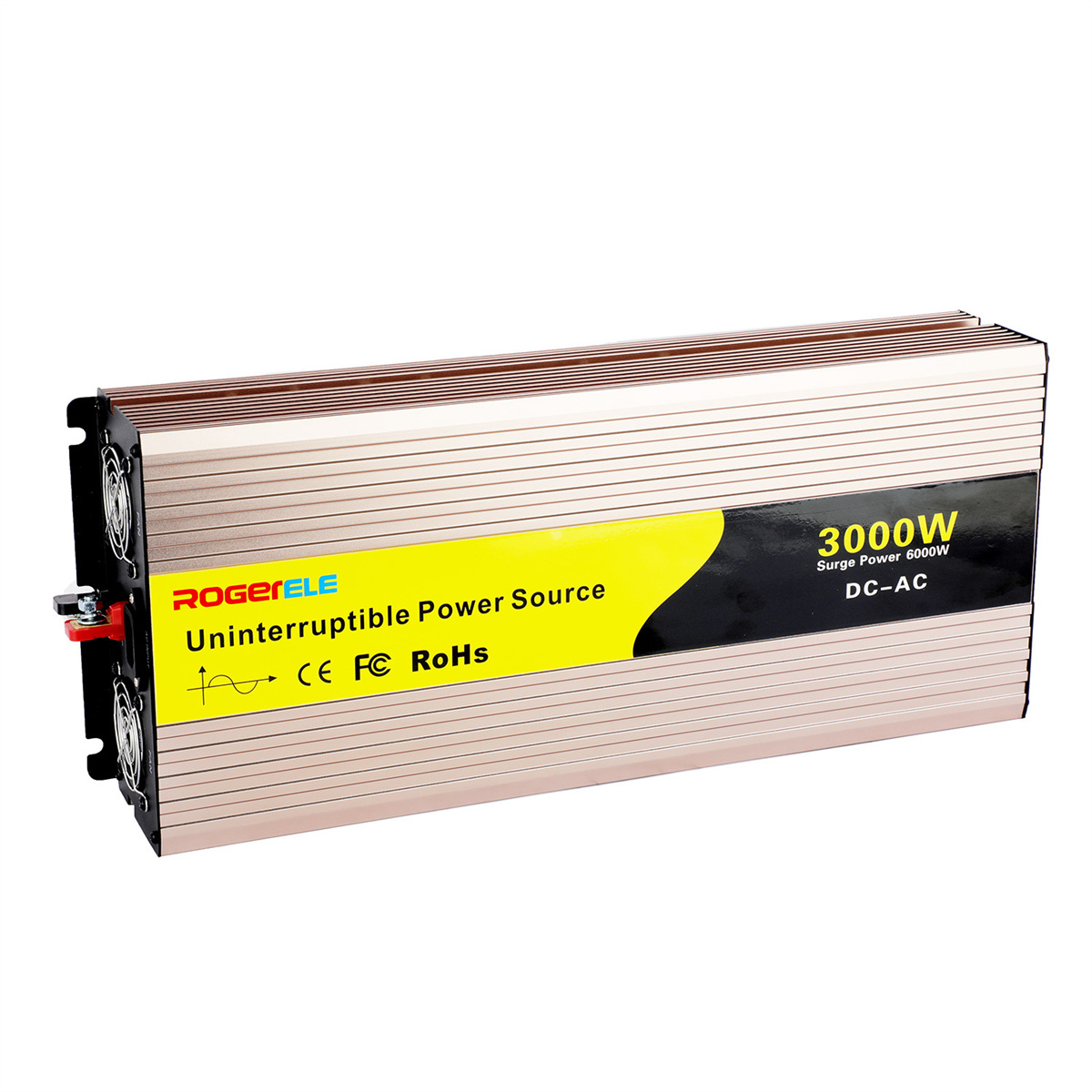
Choose an inverter with charger if your main goal is to keep the lights, router, fridge, POS terminal or security system running during grid outages, and the grid is available to recharge the battery. The Rogerele REPU series covers 300W to 5000W. For example, the REPU-3000 inverter with charger is listed with:
- 3000W rated power and 6000W peak, with pure sine wave output (THD under 3% on linear loads).
- DC12V, 24V or 48V input, and output of 100, 110, 120, 220, 230 or 240VAC at 50Hz or 60Hz.
- Built-in charge current of 30A (12V), 20A (24V) or 10A (48V).
- Low-voltage alarm and shutdown, over-voltage, overload, over-temperature and short-circuit protection.
Two limits to plan for. First, the charger is fairly small compared with the battery banks a 48V system often uses, so recharge after a long outage can take many hours. Second, the product pages do not publish a transfer time or selectable battery-type charging profiles. If either matters for your loads or your lithium battery, confirm them with the factory before ordering. The larger REPU-5000 is listed with 220/230/240VAC output only.
When should you choose a solar hybrid inverter?
A hybrid inverter combines the inverter, an MPPT solar charger and an AC charger in one box. That is usually the tidiest way to build solar-plus-storage for a home or small shop. Rogerele lists two families under solar hybrid inverters:
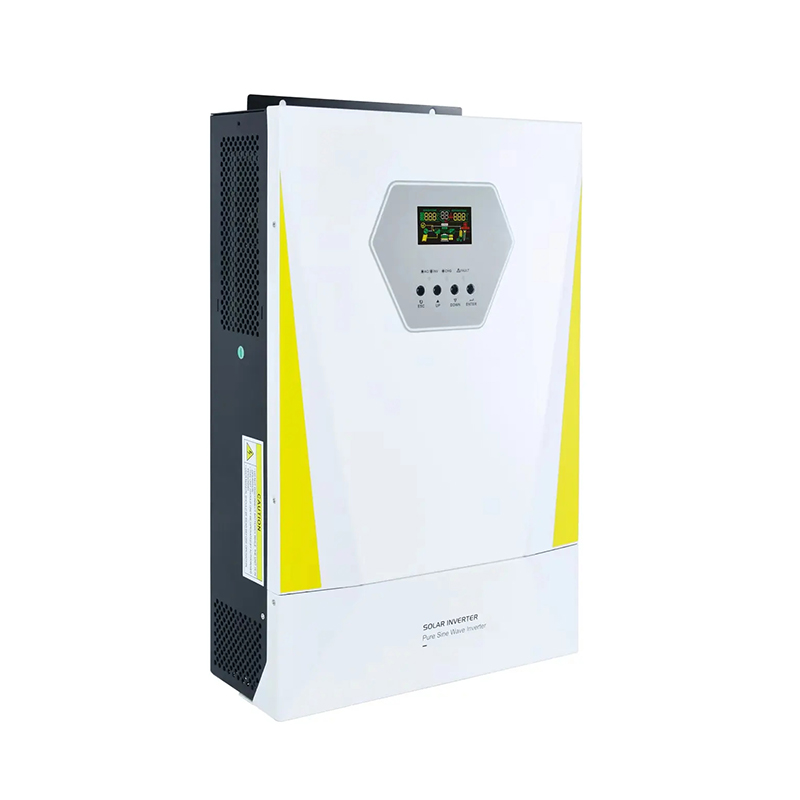
- GA series: 3000W, 3500W, 5000W and 5500W models on 24V or 48V batteries, with 208/220/230/240VAC output. Transfer time is optional at 10ms for computers or 20ms for home appliances. The page lists 500V maximum PV input, charge voltages set by default at 28.2V/27V (24V) and 56.4V/54V (48V) and marked optional, a lithium battery activation function, an expansion port for a lithium battery BMS card, and working with or without a battery.
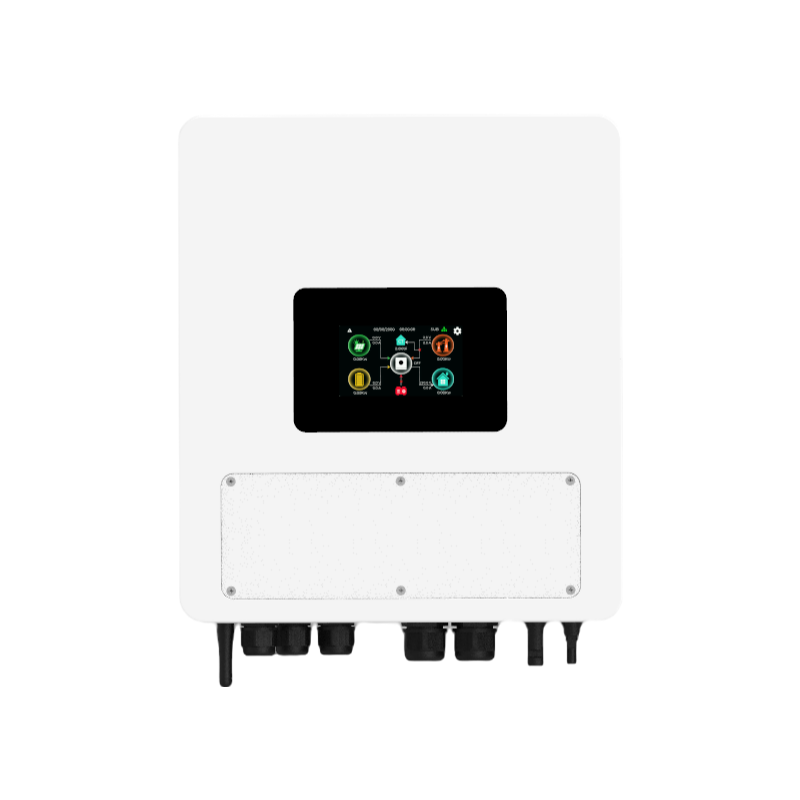
- RES-3K-65 / RES-6K-65: 3000W (24V) and 6000W (48V) models in an IP65 enclosure. The page lists grid-tied, off-grid and hybrid operating modes, up to 100A / 135A maximum charging current, and RS232/RS485/Wi-Fi communication, with CAN and dry contact on the 6K model. The 6K model can run up to 6 units in parallel.
When does a plain pure sine inverter plus charger make sense?
For off-grid cabins, vehicles, boats or custom installations, a standalone REP pure sine wave inverter paired with an MPPT solar controller or a battery charger lets you size each part separately. You also get full control of the charge voltages. The trade-off is more wiring. And without an external transfer switch, nothing changes over automatically when grid power returns or fails.
Should you pair the inverter with LiFePO4 or lead-acid batteries?
LiFePO4 costs more upfront but is lighter and tolerates deeper, more frequent cycling. Lead-acid (flooded, AGM or gel) is cheaper and simpler but heavier, and it suffers if left partly discharged. The key technical point is that the charger's voltages must match the chemistry. The values below are common reference ranges. Always use your battery maker's datasheet.
| Setting (12V nominal; ×2 for 24V, ×4 for 48V) | LiFePO4 (4 cells) | Lead-acid (AGM/flooded) |
|---|---|---|
| Nominal voltage | 12.8V | 12V |
| Bulk/absorption charge | About 14.2–14.6V | About 14.4–14.8V |
| Float | Low (about 13.4–13.6V) or disabled | About 13.5–13.8V |
| Equalization | Never | Flooded only, per maker |
| Temperature notes | Do not charge below freezing unless the battery has heating | Temperature compensation recommended |
Also check the inverter's battery protection points against the battery's BMS. For example, the 12V REPU models alarm at 10.5V and shut down at 10V (21V/20V on 24V, 42V/40V on 48V). The BMS must supply the inverter's full and surge current without tripping first.
How much does transfer time matter?
When the grid fails, a UPS-type inverter switches the load to the battery. Lights, fridges and fans usually ride through a short gap without problems. Desktop computers, servers and some medical or network devices are more sensitive. For those, choose a unit with a published transfer time suited to IT equipment (the GA series lists 10ms for computers) and test your actual devices. For truly critical IT loads, consider adding a dedicated online UPS.
FAQ
Is an inverter with charger the same as a UPS?
It does the same basic job: it charges the battery from the grid and switches loads to battery power during an outage. However, switch-over time, charger size and output quality vary by product, so check the specs for your loads.
Can I use LiFePO4 batteries with a UPS inverter?
Often yes, if the charger voltages suit LiFePO4 and the BMS can handle the inverter's current. The REPU product pages do not list a lithium charging mode, so confirm the charge profile with Rogerele before ordering.
Do I need 12V, 24V or 48V for home storage?
The REPU inverters come in 12V, 24V and 48V versions. The GA and RES hybrid inverters use 24V or 48V. Higher voltage means lower current and easier wiring for larger systems.
Can a hybrid inverter work without batteries?
The GA series page states that it can work with or without a battery. The RES models list grid-tied operation. Confirm the behavior for your exact configuration.
Can Rogerele supply OEM or custom energy storage inverters?
Yes. Rogerele is a manufacturer and invites bulk and custom enquiries. Send your battery type, voltage, output voltage and frequency, and your loads through the contact page.
