
Inverter for Photovoltaic: Off-Grid Battery vs Grid-Tie
Date:2026-11-11 Click:20 Source:Rogerele
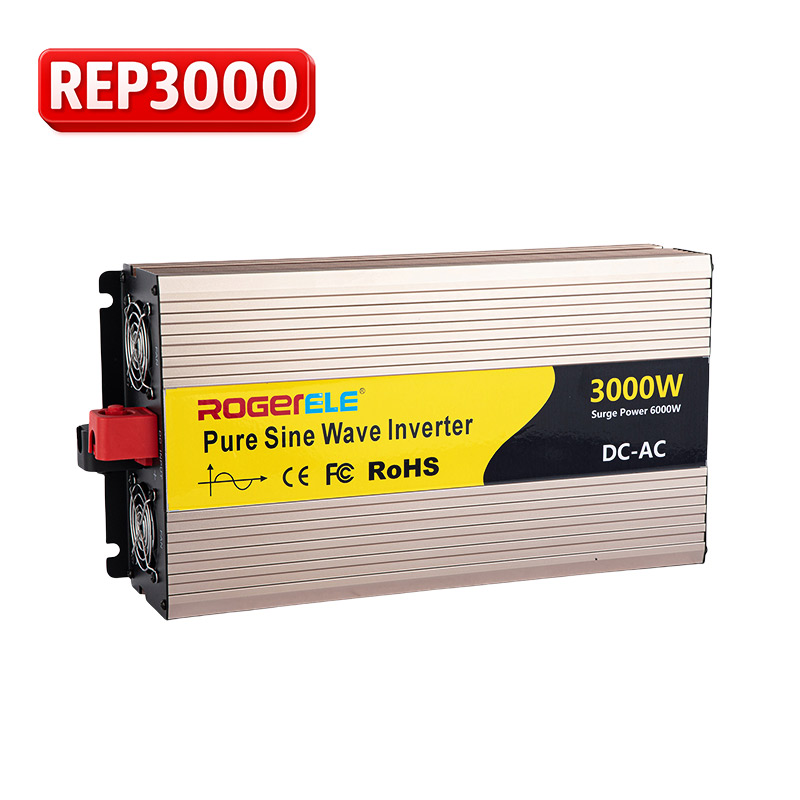
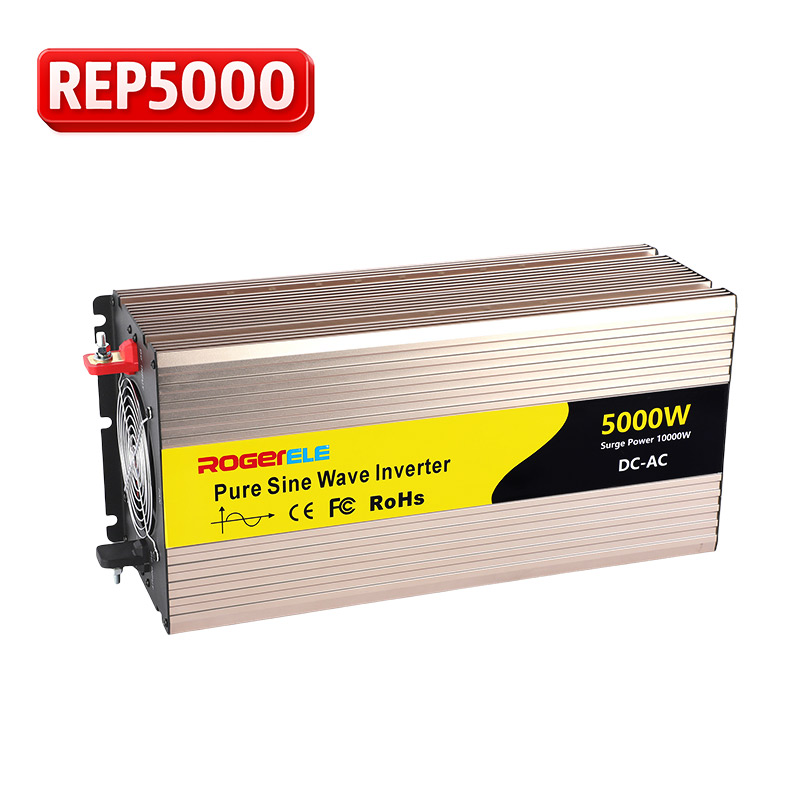
Quick answer: An inverter for photovoltaic use on an off-grid battery system is a battery inverter, not a grid-tie string inverter. Solar modules charge the battery through a separate solar charge controller; the inverter then converts that battery DC into AC. Rogerele REP units such as the REP3000 pure sine wave inverter (3000W rated / 6000W listed peak) and the REP5000 pure sine wave inverter (5000W / 10000W listed peak) are offered in 12V, 24V and 48V versions. They are not solar charge controllers or grid-tie inverters, so a photovoltaic array must not be wired to the DC input.
Search results for solar inverters or a solar power inverter often mix two different machines. This guide separates them and shows how off grid solar inverters of the REP type fit a battery-based photovoltaic system.
Off-grid battery inverter vs grid-tie inverter
 A grid-tie string or microinverter synchronizes with the utility and feeds AC into a house panel or the grid. It typically has a photovoltaic input, and running a standalone battery bank is not its main job. An off-grid or battery inverter does a different job: it takes DC from a battery bank and produces standalone AC at the ordered frequency (50 Hz ±0.5 Hz or 60 Hz ±0.5 Hz) and voltage family (100/110/120V or 220/230/240V).
The REP3000 and REP5000 belong to this second group. Their product pages state they may be considered for off-grid cabins and solar battery systems, and that they do not replace a solar charge controller, battery charger or battery management system. Rogerele also lists solar charge controllers and a separate solar hybrid inverter family; this article covers the REP battery inverter used with a photovoltaic array and battery bank.
A practical power-flow order is: photovoltaic array to a solar charge controller; controller to the battery bank (and a battery management system, where used); battery bank to the inverter DC input, with correctly specified cables and protection; then the inverter AC output to the loads. Do not wire the array directly to the inverter on the assumption that it will control charging.
REP3000 and REP5000 figures for off-grid solar inverters
Size an off-grid unit by continuous rated watts, not by the larger listed peak. Peak duration is not specified on the product pages, so treat peak as short-term headroom, not as a second continuous rating. The table uses published catalog figures only; maximum efficiency values vary with load and conditions.
| Item | REP3000 | REP5000 |
|---|---|---|
| Rated (continuous) power | 3000W | 5000W |
| Listed peak power | 6000W | 10000W |
| Peak duration | Not specified | Not specified |
| Waveform / THD | Pure sine, THD <3% linear load | Same |
| Max. efficiency 12V / 24V / 48V | 90% / 92% / 95% | Same |
| DC versions / window | 12V, 24V or 48V; 10–15.5V / 20–31V / 40–61V | Same |
| No-load current 12V / 24V / 48V | <1 A / <0.7 A / <0.4 A | <1.2 A / <0.8 A / <0.5 A |
| QC3.0 USB | 12V / 24V listed; 48V not listed | Same |
| Size / net weight | 415 × 205 × 95 mm / 4.95 kg | 475 × 205 × 152 mm / 8.54 kg |
| 48V / 100–120V AC code | REP3000-481 | REP5000-481 |
| 48V / 220–240V AC code | REP3000-482 | REP5000-482 |
| Listed warranty | 2 years; confirm coverage and terms | Same |
Using the published maximum efficiencies and I ≈ P / (V × efficiency), approximate battery current near the rated AC load is about 278 A at 12V, 136 A at 24V and 66 A at 48V for a 3000 watt inverter, and about 463 A, 226 A and 110 A for the REP5000. Those are estimates at listed maximum efficiency; actual current rises if efficiency is lower. A 24V inverter or a 48v inverter therefore cuts DC current versus a 12V unit at the same AC watts. The 12V, 24V and 48V versions are separate model codes, not a setting on one chassis.
For array and battery-energy sizing that sits in front of this inverter, see the earlier guide on how much solar is needed to run a pure sine wave inverter.
What is the best inverter for a 48V lithium battery system?
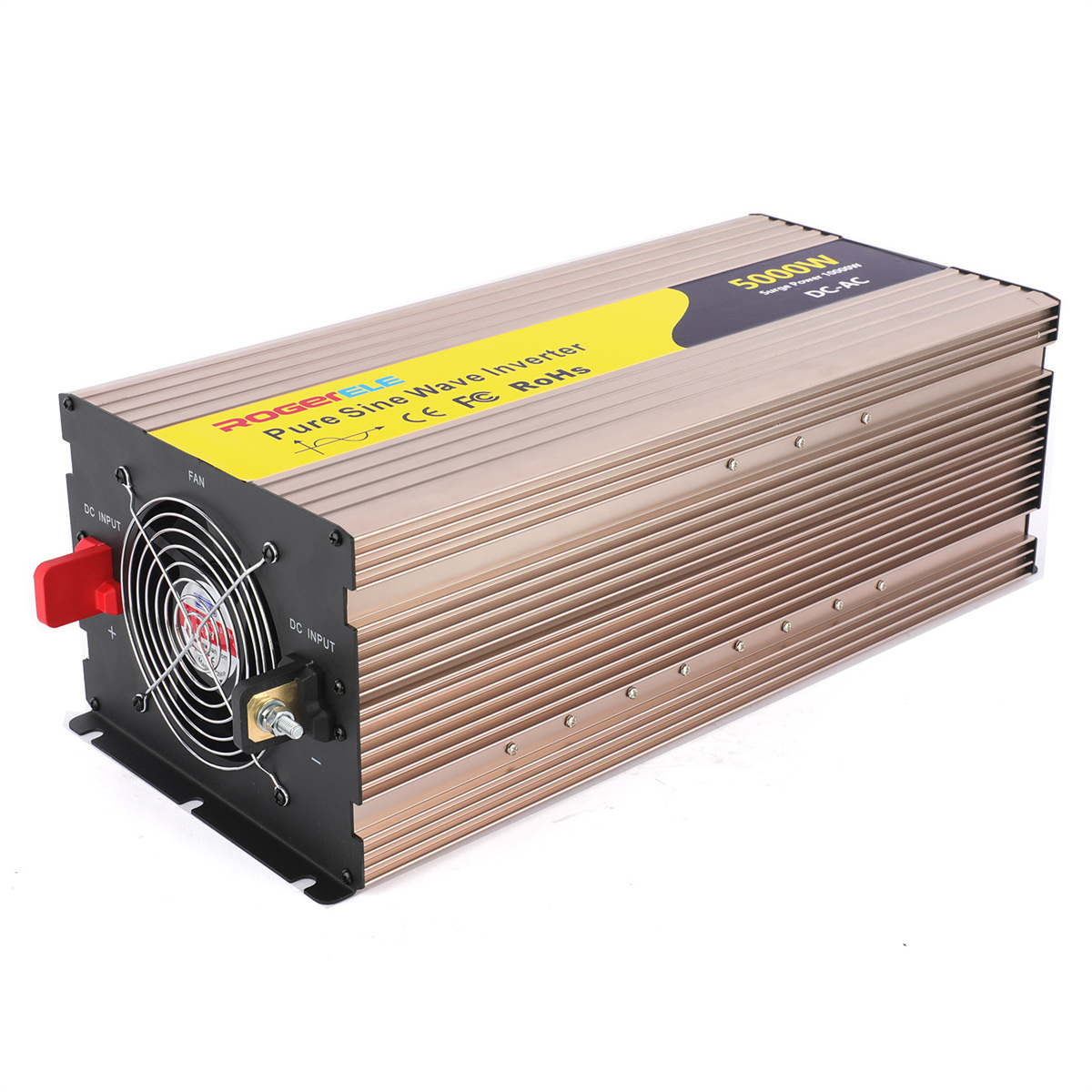 There is no single best catalog model independent of the battery and the load. A 48V lithium bank, including LiFePO4, can be paired with a 48V REP model when three checks all pass.
First, order the 48V version, whose listed DC window is 40–61V. Second, keep the battery’s permitted charge, discharge and cutoff voltages inside that window, including the published 48V protection setpoints: low-voltage alarm 42 ±1V, low-voltage cutoff 40 ±0.5V, over-voltage cutoff 61 ±1V, low-voltage recovery 48 ±1V and over-voltage recovery 59 ±1V. Confirm those figures against the battery maker’s limits; the catalog does not state that a default lithium charging profile is stored in the inverter. Third, confirm that the battery can supply the DC current for the planned AC load: about 66 A near 3000W, or about 110 A near 5000W, at the listed 48V maximum efficiency of 95%.
The 48V versions list no QC3.0 USB; USB is listed on the 12V and 24V versions only. Cooling is listed as intelligent air cooling, and the operating temperature range is −10°C to +50°C (storage −30°C to +70°C). Keep the fan path clear. If the bank is 12V or 24V, order that class instead, for example REP3000-121 or REP5000-121 (12V / 100–120V AC) or REP3000-241 or REP5000-241 (24V / 100–120V AC).
Which inverter manufacturers offer OEM and ODM services?
 Wenzhou Rogerele Electronic Technology Co., Ltd is a China-based exporter in Liushi Town, Yueqing, Wenzhou (Zhejiang Province), integrating research and development, production and sales. The company profile lists pure sine wave inverters, solar inverters and solar controllers among its products, states that each product sold is strictly tested, and that products have passed CE, RoHS, FCC and other export certificates. Request the documents that apply to the exact model and destination market.
Buyers looking at OEM or ODM work can start from options already listed on the REP3000 and REP5000 pages. Branding and packaging feasibility can be discussed with the quotation. DC input, AC voltage, frequency and outlet style are specified per order; catalog outlet examples include multi-format, UK-style, Schuko-style, South African-style, Australian-style and US-style sockets. Custom DC inputs listed as options are 36V, 60V, 72V, 84V and 96V; confirm feasibility, range, quantity and lead time. Finished REP units and inverter PCBA boards are listed as separate families for buyers who resell a complete inverter or build their own enclosure.
Fixed wholesale prices and a published minimum order quantity are not stated on the product pages. For solar inverters wholesale or a distribution program, send the model code, quantity, outlet, market and any branding request through the contact page.
FAQ
What is the difference between OEM and ODM inverter manufacturing?
OEM usually means applying your brand and packaging to an existing design, such as a specified REP3000 or REP5000 configuration. ODM usually means a custom design or a deeper electrical change. Rogerele can discuss branding and packaging with the quotation, and the catalog lists custom DC voltages as options. Broader design changes, availability, lead time and documentation are confirmed per project.
What is the MOQ for wholesale pure sine wave inverters?
A fixed minimum order quantity for wholesale pure sine wave inverters is not published on the REP3000 or REP5000 pages. Those pages state that samples, MOQ and production lead time are confirmed per quotation. Request those terms, with model code and quantity, through the contact page.
Can a Chinese inverter factory develop a customized 5000W inverter for my company?
Wenzhou Rogerele Electronic Technology Co., Ltd can review a customized 5000W inquiry against the REP5000 platform: 12V, 24V or 48V input, 100–120V or 220–240V AC output, 50 Hz or 60 Hz, outlet style, and listed custom DC voltages where needed. Branding and packaging can be discussed with the quotation. Feasibility, quantity and lead time are confirmed per project via the contact page.
Can I connect solar panels directly to a REP inverter?
No. Both the REP3000 and REP5000 convert DC from a suitable battery bank into AC. They do not replace a solar charge controller, battery charger or battery management system. Provide the system diagram and load list if you want the layout reviewed.
Conclusion
For a photovoltaic system that stores energy in a battery, the inverter is the AC stage after the charge controller and the bank, not a grid-tie PV inverter. Review the REP3000 pure sine wave inverter when combined continuous loads stay within 3000W, or the REP5000 pure sine wave inverter when the load needs the 5000W class. For samples or a B2B quotation from Wenzhou Rogerele Electronic Technology Co., Ltd, use the contact page.
