
How Much Solar Do I Need to Run a Pure Sine Wave Inverter?
Date:2026-10-02 Click:25 Source:Rogerele
Quick answer: In a typical off-grid or cabin setup, solar panels charge a battery bank through a charge controller; a pure sine wave inverter then draws DC from that battery to make AC for your loads — it does not usually pull power straight from the PV array. Size three things: (1) inverter continuous and peak watts for the AC loads, (2) battery watt-hours for nightly or cloudy runtime, and (3) PV watts using a general-practice estimate of daily AC Wh ÷ peak sun hours ÷ system efficiency. The sections below walk through each step with example loads and Rogerele REP / REPU model fits.
If you already know your AC loads, start with inverter sizing, then battery and panels. Related guides: what size inverter for home battery backup, how long a battery will run an inverter, LiFePO4 vs lead-acid for inverter backup, and MPPT vs PWM solar charge controller.
How does solar connect to a pure sine wave inverter?
Think of three layers, not one “solar inverter” box:
- PV panels + charge controller put energy into the battery (and protect it from overcharge).
- Battery bank stores watt-hours for night, clouds, and surge demand.
- Pure sine inverter turns battery DC into clean AC (100/110/120 or 220/230/240 V, 50 or 60 Hz) for appliances.
Rogerele REP pure sine wave inverters are battery-to-AC units. The REPU inverter-with-charger (UPS) series adds an AC charger path so shore or utility power can recharge the bank and support loads — useful when you also have grid or generator AC. Neither product line should be assumed to include a built-in solar MPPT unless a specific product page says so. For solar into the battery, use a separate controller and read our MPPT vs PWM comparison. For UPS vs hybrid roles, see UPS inverter vs hybrid inverter.
How do I size the pure sine inverter for my AC loads?
List every AC load you will run at once. Add continuous watts. Note motor or compressor surge (often 2–3× running watts for a few seconds — general practice). Choose an inverter whose continuous rating covers simultaneous loads and whose peak rating covers the largest surge.
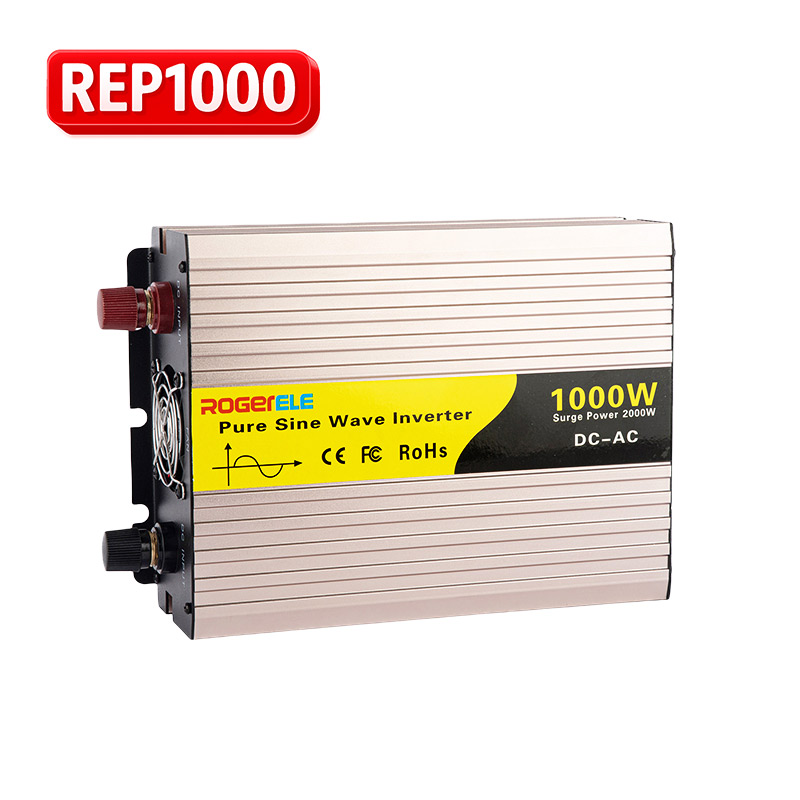
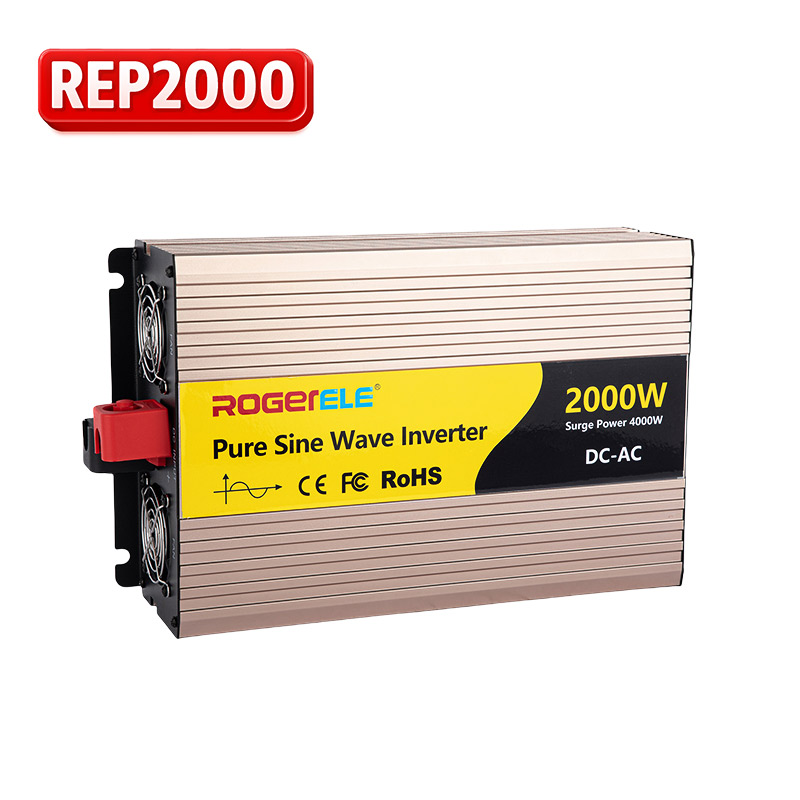
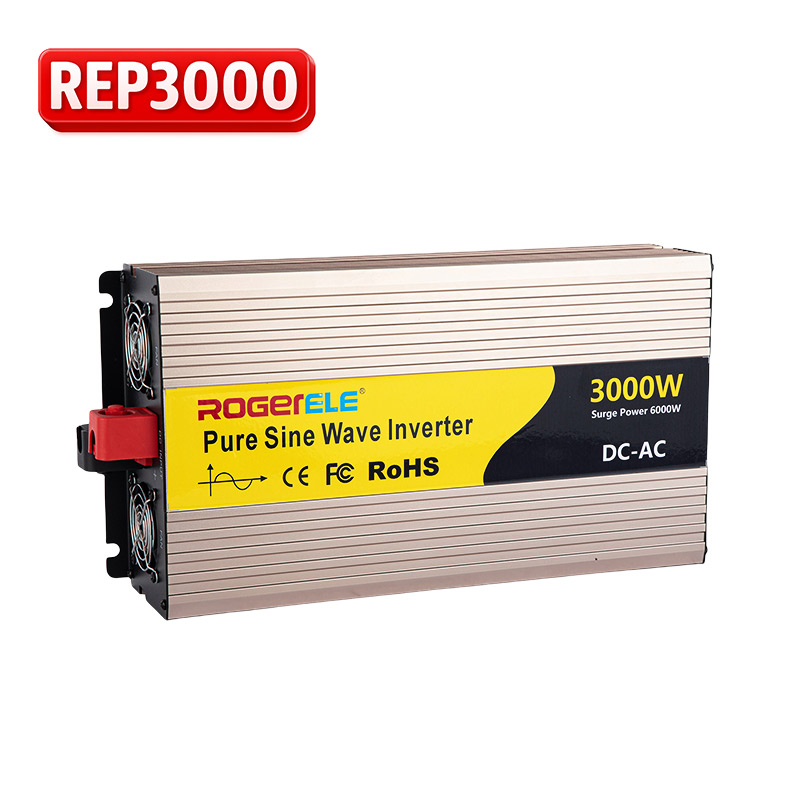
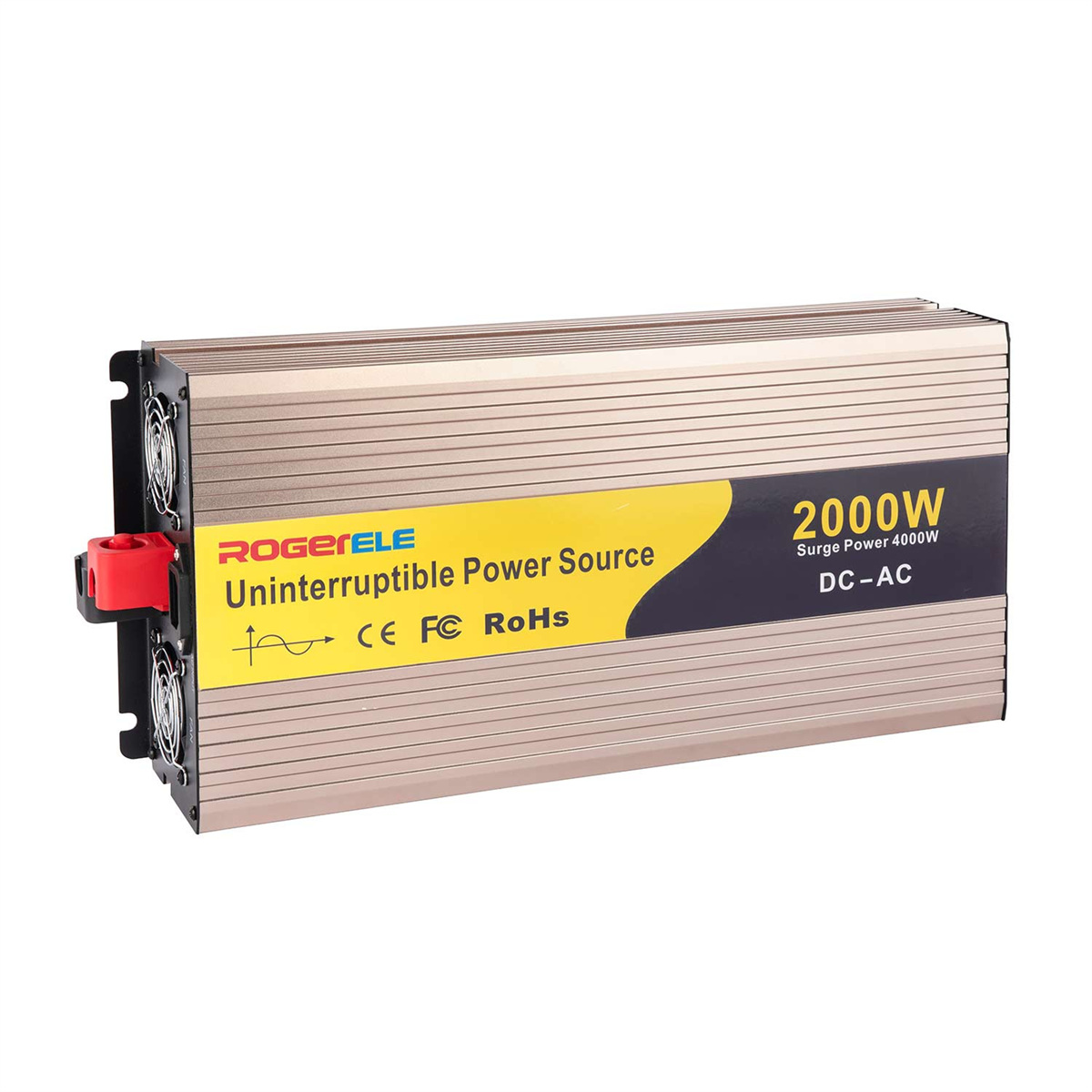
Verified Rogerele continuous / peak ratings (live product pages): REP1000 1000W / 2000W peak (~275×180×80 mm, ~2.5 kg, efficiency about 90/91/93% on 12/24/48V, THD <3% linear, 2-year warranty); REP2000 2000W / 4000W (~355×205×95 mm, ~3.9 kg, ~90/92/95%); REP3000 3000W / 6000W (~415×205×95 mm, ~4.95 kg, ~90/92/95%); REPU-2000 2000W / 4000W UPS inverter-charger with charge current 30/20/10A on 12/24/48V.
Output options include 100/110/120 or 220/230/240 V ±5% and 50 or 60 Hz ±0.5 Hz. Input windows follow 10–15.5 / 20–31 / 40–61 V by DC class, with LV alarm near 10.5/21/42 V and LV protect near 10/20/40 V. Working temperature is listed −10 to +50°C. Unload current still drains the bank (e.g. under ~0.4/0.3/0.2 A on REP1000; under ~0.9/0.5/0.3 A on REP2000 / REPU-2000) — switch the inverter off when idle.
How much battery capacity do I need before I size solar?
Solar replaces energy over the day; the battery covers nights and cloudy stretches. A simple planning formula (general practice):
Usable Wh needed ≈ average AC watts × hours ÷ inverter efficiency (use ~0.90 as a rough planning factor for these REP units). Then size the bank for usable DoD — often ~50% for lead-acid planning and ~80–90% for LiFePO4 with a BMS (general practice; see our chemistry comparison). For runtime math, see battery runtime with an inverter.
How many solar watts do I need to recharge that bank?
A common general-practice estimate: PV watts ≈ daily AC energy (Wh) ÷ peak sun hours ÷ system efficiency. Peak sun hours are site- and season-dependent (many temperate sites start around roughly 3–5 hours in a mild season — use a local solar map; not a Rogerele lab number). System efficiency often lands around 0.70–0.85 after controller, wiring, temperature, and inverter losses (general practice). Example: 2,000 Wh/day, 4 peak sun hours, 0.75 efficiency → 2,000 ÷ 4 ÷ 0.75 ≈ 667 W of PV. Add margin for clouds and future loads. Match the controller to panel Voc/Isc and battery voltage — prefer MPPT when array voltage is well above the battery or shade/winter matter; PWM can fit small matched arrays (MPPT vs PWM).
Example daily loads → inverter, battery, and PV notes
The table below is for illustration only (general practice). Confirm nameplate watts, surge, and local sun hours before you buy.
| Example daily use (illustrative) | Rough daily AC Wh | Suggested REP continuous size | Rough PV & battery notes (general practice) |
|---|---|---|---|
| Laptop, LED lights, phone charging, small fan | ~400–800 Wh | REP1000 (1000W / 2000W peak) | Often ~200–400 W PV and a modest 12V bank sized for usable Wh + cloudy margin |
| TV, router, fridge (efficient), tools or blender bursts | ~1,200–2,500 Wh | REP2000 or REPU-2000 if shore charge needed | Often ~500–900 W PV; larger 12/24V bank for fridge overnight |
| Cabin kitchen days: microwave bursts, coffee maker, multiple outlets | ~2,500–4,500 Wh | REP3000 (3000W / 6000W peak) | Often ~900–1,500 W+ PV; 24/48V bank recommended as current rises |
When should I choose REPU instead of a plain REP inverter?
Pick REP when solar (or a separate charger) is your main recharge path and you only need clean AC from the battery. Pick REPU when shore or generator AC should also charge the bank and support loads. REPU-2000 lists 30/20/10A charge on 12/24/48V — confirm chemistry fit. Do not assume built-in solar MPPT on REP/REPU unless a product page says so; keep a dedicated PV controller.
What wiring and protection basics should I not skip?
Use short, heavy DC cables between battery and inverter to limit drop into the LV window. Fuse the positive near the battery to protect the cable. Keep PV on the controller terminals — never wire panels into the inverter DC input. Match 12/24/48V across battery, controller, and inverter. Follow local codes and a qualified installer for permanent work.
FAQ
Can I run a pure sine inverter directly from solar panels?
Not in the simple off-grid layout here. Panels go to a charge controller and battery; the inverter draws from the battery. Direct PV-to-inverter needs hybrid/grid-tie gear — different from Rogerele REP/REPU battery inverters.
Do I need MPPT if I already have a pure sine inverter?
Yes, separately: MPPT or PWM sits between panels and battery. See MPPT vs PWM.
How many peak sun hours should I use in the PV formula?
Use a local solar estimate for your worst season (winter for year-round cabins). Roughly 3–5 hours is only a temperate starting point — replace it with site data (general practice).
Is a 1000W inverter enough for a small solar cabin?
Yes for lights, electronics, and modest tools if continuous load stays under 1000W and surges under 2000W. Step up to REP2000 or REP3000 for kitchen loads. Size battery and PV from daily Wh, not the inverter sticker alone.
Does REPU replace my solar charge controller?
No. REPU adds an AC charger/UPS path. Solar still needs a PV charge controller unless another hybrid product explicitly includes MPPT on its datasheet.
Browse the full REP pure sine wave inverter series and REPU inverter-with-charger UPS series to match continuous watts, DC voltage, and whether you need shore charging alongside solar.
