
What Size Inverter Do I Need to Run a Microwave in a Truck or RV?
Date:2026-10-02 Click:29 Source:Rogerele
Quick answer: Do not size the inverter from the cooking watts on the microwave door. Read the AC input watts (or amps) on the nameplate, multiply by about 1.25, and pick a pure sine wave inverter whose continuous rating covers that number and whose peak rating covers startup. A compact unit that truly draws under about 1200W can run on a 1500W inverter alone. Most 900–1200W cooking models in a truck or RV need a 2000W or 3000W pure sine inverter, hard-wired to the battery: 12V on a car or pickup, 24V on a heavy truck. A cigarette-lighter socket cannot feed a microwave.
This page is only about microwave loads on US-style 120V, 60Hz power. For the general method, see what size inverter for a car or truck. For cable and fuse placement, see how to install a car power inverter. For amp-hours, see how long a battery will run an inverter. For waveform, see pure sine vs modified sine wave.
Why the number on the microwave door is the wrong wattage
The 700W, 900W or 1000W figure on the door is cooking power, roughly what reaches the food. The nameplate lists input watts, or input amps. On a 120V US microwave, amps times 120 estimates input watts when watts are not printed (general practice; if both are printed, use watts).
Input is higher than cooking power because the transformer, fan and controls also draw power. A 700W cooking unit can still pull well over 1000W. A 1000W cooking unit often sits around 1400–1700W input. Models differ, so the label wins. Startup spikes briefly when the transformer magnetizes. On the REP pages below, rated power is continuous and peak power is twice that rating.
How to turn the nameplate into an inverter size
- Find input watts (or amps 120).
- Multiply by 1.25 so the inverter is not pinned at 100% for the whole cook.
- Confirm the peak rating can cover startup. Matching continuous watts to running input is not always enough.
- Add anything else on that inverter at the same time, such as a fridge compressor or galley lights.
- Skip the cigarette lighter. Accessory sockets are commonly fused around 10–15A, about 120180W at 12V (general vehicle practice).
A 1000W pure sine wave inverter (REP1000: 1000W rated, 2000W peak) is usually too small. It suits a laptop and a small fridge, not a microwave whose input is already near 1000W. Overload on these REP units shuts the inverter down and lights the red LED.
Which REP pure sine model fits a US 120V truck or RV
Rogerele REP pure sine wave inverters convert 12V, 24V or 48V DC into AC. For the United States, choose 100VAC, 110VAC or 120VAC ±5% and 60Hz ±0.5Hz. The “-121” suffix is 12V DC in and 100–120V AC out. “-241” is the same AC output on 24V DC, which matches many heavy trucks. -122 and -242” are 220–240V output, the wrong voltage for a standard US microwave.
These pages list one output-voltage family, not 120/240V split-phase. A microwave needs the 120V family. Waveform is pure sine, THD under 3% on a linear load. Listed efficiency is 90% on 12V, 92% on 24V and 95% on 48V. Cooling is intelligent air cooling, warranty is 2 years. No-load current is under 0.8A at 12V on the 1500W model, under 0.9A on 2000W and under 1A on 3000W. Switch the inverter off between cooks.
| Nameplate input (check yours) | REP continuous / peak | US 120V, 60Hz example |
|---|---|---|
| Under about 1100–1200W, microwave alone | 1500W / 3000W | REP1500-121 (12V) or REP1500-241 (24V) |
| About 1200–1600W | 2000W / 4000W | REP2000-121 or REP2000-241 |
| Above about 1600W, or microwave plus another load | 3000W / 6000W | REP3000-121 or REP3000-241 |
| Any microwave on a 12V socket | Not suitable (socket typically 120–180W) | Hard-wire to the battery |
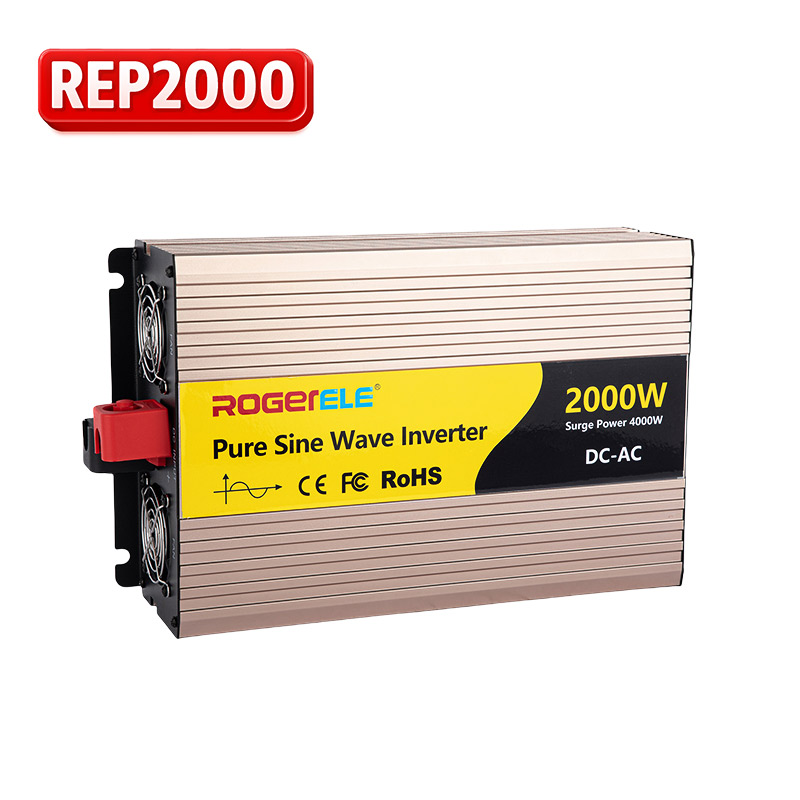
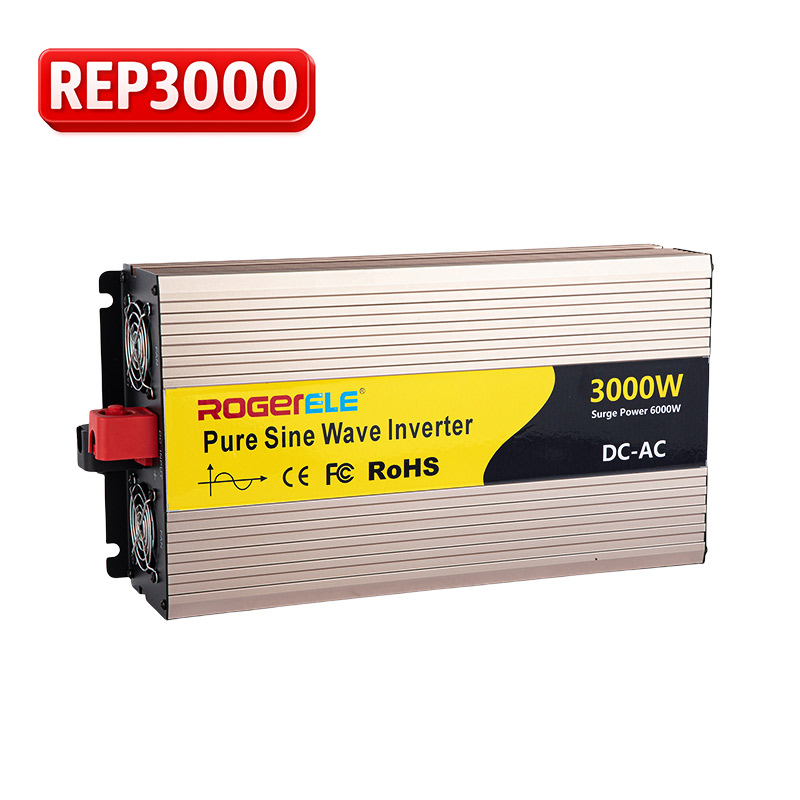
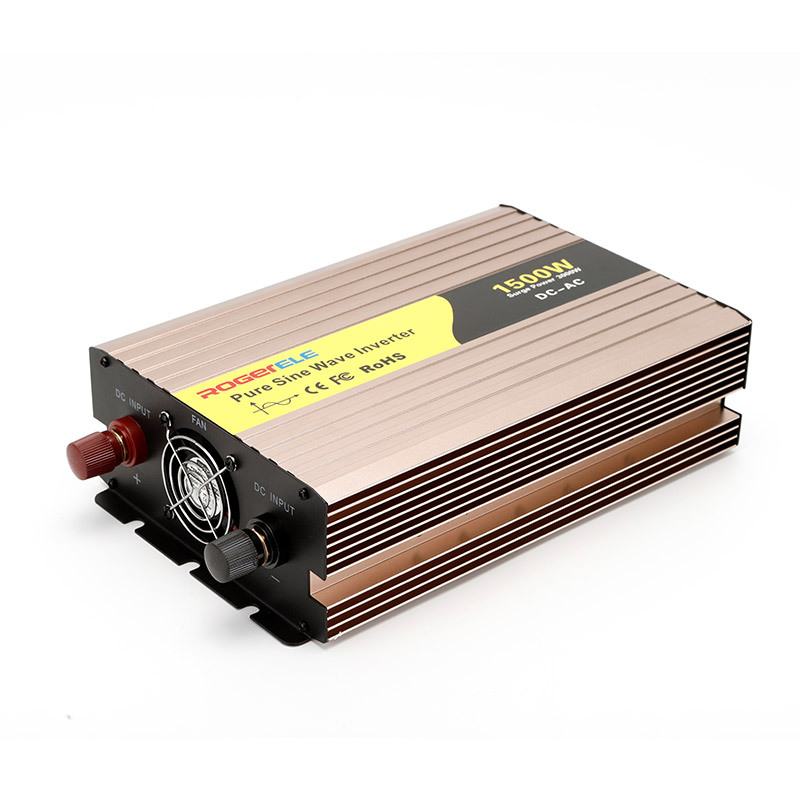
Treat 1500W as the edge case (310 × 180 × 80 mm, about 2.9 kg). If it drops out at Start, the input is over the continuous rating or the battery is sagging. The 2000W model (355 × 205 95 mm, about 3.9 kg) fits many 12001600W input ovens. The 3000W model (415 × 205 × 95 mm, about 5.0 kg) is safer when the label is higher, a fridge may start during the cook, or a 12V bank sags.
Why 12V current, not the AC plug, is the hard part
About 12A at 120V looks like a normal household plug. DC current is AC watts ÷ battery volts ÷ efficiency. Using the efficiencies on the REP pages:
- 1500W at 12V and 90% is about 139A.
- 2000W at 12V and 90% is about 185A.
- 2000W at 24V and 92% is about 91A.
- 3000W at 12V and 90% is about 278A.
- 3000W at 24V and 92% is about 136A.
A 24V truck is the cleaner base for 2000W or 3000W: about half the 12V current, less voltage drop, less cable heat. Do not put a 12V inverter on a 24V truck. REP 12V models list an input range of 10–15.5V and over-voltage protection at 15.5V ±0.5V. Tapping one battery of a 24V pair to fake 12V unbalances the pair. Use a 24V-input inverter (20–31V range) instead.
Low voltage is the other shutdown. 12V models alarm around 10.5V ±0.5V and cut off around 10V ±0.5V. A thin cable or a weak battery can hit that during the cook. REP pages do not publish a cable chart, so size both cables for the DC current above and fuse the positive lead at the battery.
Battery, alternator, and a short cook cycle
Energy is often modest even when current is not. Ten minutes at 1400W AC is about 233 watt-hours. At 90% efficiency that is about 259Wh from the battery, roughly 22Ah at 12V. A few meals do not need a huge bank. The battery still has to hold voltage above the low-voltage cut-off, and the engine still has to start afterward.
Do not hang this inverter on the starter alone if a no-start would strand you. Use a deep-cycle AGM or LiFePO4 house battery with an isolator or DC-DC charger see whether you need an auxiliary battery. Many car alternators cannot cover 150A or more continuously, so the house battery still supplies the peaks (general practice). Working temperature on these pages is −10°C to +50°C. Leave airflow; over-temperature protection alarms, then shuts down.
FAQ
Can a 1500W inverter run a microwave?
Sometimes. If nameplate input is under about 1100–1200W, input × 1.25 still fits in 1500W, and the 3000W peak covers startup, a REP1500 can run that microwave by itself. Many RV ovens list a higher input and need 2000W or 3000W continuous.
Can I plug the inverter into the cigarette lighter?
No. A lighter socket is typically fused near 10–15A. Microwave current on 12V is on the order of 100A and up. Hard-wire the inverter to the battery, with a fuse at the positive post.
Do I need a pure sine wave inverter for a microwave?
Yes for this job. The transformer and control board expect a utility-like waveform. The REP models above are pure sine wave. Modified sine wave is a different product line and a poor match for a microwave.
Should a heavy truck use 12V or 24V input?
Match the truck. A 24V system needs a 24V inverter such as REP2000-241 or REP3000-241, with 100–120V output at 60Hz. A 12V pickup uses the -121 models. 48V input (40–61V) is on the same pages but is not a normal car or light-truck system.
Will one microwave cycle drain the battery?
Usually not by itself. Ten minutes near 1400W is on the order of 20Ah at 12V after efficiency. The usual failure is voltage sag or overload, not an empty battery after one meal. Several cooks with the engine off belong on a house bank.
