
Air Fryer Inverter Size: 1500W vs 2000W in an RV
Date:2026-10-27 Click:23 Source:Rogerele
Quick answer: Most compact 2 to 3 qt travel air fryers draw about 900 to 1,200W and sit comfortably under a 1500W pure sine inverter. Mid-size 4 to 5 qt and full-size 5 to 7 qt or dual-basket models often draw 1,400 to 1,800W for 20 to 40 minutes, so a 2000W pure sine inverter with about 20% headroom is the safer RV choice. Keep long cooks under about 80% of the inverter rating.
The problem shows up on weekend RV trips: the air fryer starts, then halfway through a batch the inverter beeps, the display dims, or the unit cycles off. That is rarely a fault in the fryer. Heating-element loads are mostly continuous resistive watts with only a mild surge, so continuous rating, battery current and cable size decide whether a cook finishes cleanly. This guide works through typical air fryer wattages, the 80% continuous-load rule, 12V current and battery size, and compares two Rogerele pure sine models, the REP1500-121 and the REP2000-121.
How many watts does an RV air fryer use?
Air fryers sold for 120V outlets list watts on the rating label; treat the ranges below as typical and always check your own label. Compact travel units for 2 to 3 qt baskets usually run about 900 to 1,200W. Mid-size 4 to 5 qt baskets often sit near 1,400 to 1,500W. Full-size 5 to 7 qt or dual-basket models commonly draw 1,500 to 1,800W while the heater is on. Unlike a blender or compressor, the surge is mild, but the heater stays on for much of a 20 to 40 minute cook, so continuous watts matter more than peak. The 12V current column assumes about 90% inverter efficiency, so 12V amps are roughly watts divided by 10.8.
| Air fryer (120V, typical) | Running watts | 12V DC current (approx.) | 1500W | 2000W |
|---|---|---|---|---|
| Compact 2 to 3 qt travel | 900 to 1,200W | 83 to 111A | Yes | Yes |
| Mid-size 4 to 5 qt | 1,400 to 1,500W | 130 to 139A | Tight / at limit | Yes |
| Full-size 5 to 7 qt or dual basket | 1,500 to 1,800W | 139 to 167A | No margin | Yes |
| 1,500W fryer plus 100W lights and phone charge | about 1,600W | about 148A | No | Yes |
| 1,700W fryer plus another small AC load | about 1,800W+ | about 167A+ | No | Tight |
For a load that runs 20 minutes or more, keep it under about 80% of the inverter's continuous rating. That is about 1,200W on a 1500W inverter and about 1,600W on a 2000W inverter. A mid-size 1,500W fryer already sits at the 1500W continuous limit, which leaves no room for other AC loads or for battery voltage sag near the end of a cook.
Why continuous watts matter more than surge
An air fryer's heater is mostly a resistive load. Start-up inrush is usually modest compared with induction motors, so peak rating alone rarely decides the size. What matters is holding 900 to 1,800W for the whole cook while battery voltage falls. If the bank sags toward the 10.5V low-voltage alarm, the same fryer that started fine can trip midway. Pure sine (THD under 3% on a linear load) keeps the fryer's electronics as quiet and stable as on a shore outlet.
When 1500W is enough
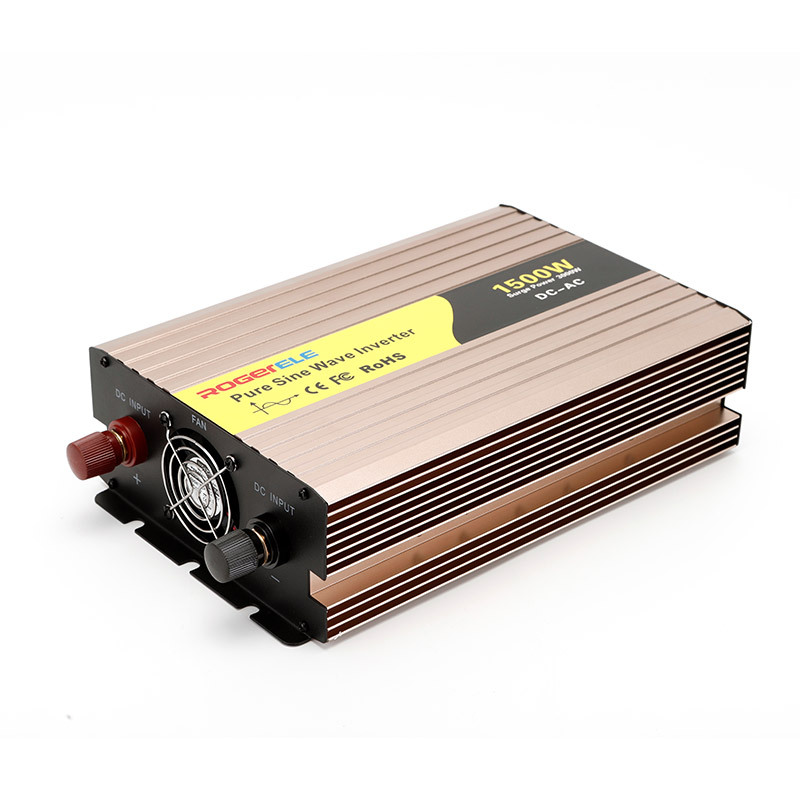 If you cook with a compact 2 to 3 qt travel air fryer rated about 900 to 1,200W and run little else on AC at the same time, the REP1500 pure sine wave inverter keeps the RV install smaller and lighter. The REP1500-121 is rated 1500W continuous with a 3000W peak, pure sine THD under 3% on a linear load, 12V input (10 to 15.5V), and max efficiency 90%/92%/95% on 12/24/48V. No-load current is under 0.8A on 12V. It measures 310 × 180 × 80 mm and weighs 2.9 kg, with low-voltage alarm/cutoff at 10.5V/10V and USB QC3.0 on 12/24V versions. Full-load battery current is about 139A. Eighty percent of 1500W is about 1,200W — if your label reads 1,400W or more, or you want other AC loads on, step up to 2000W.
When to choose 2000W
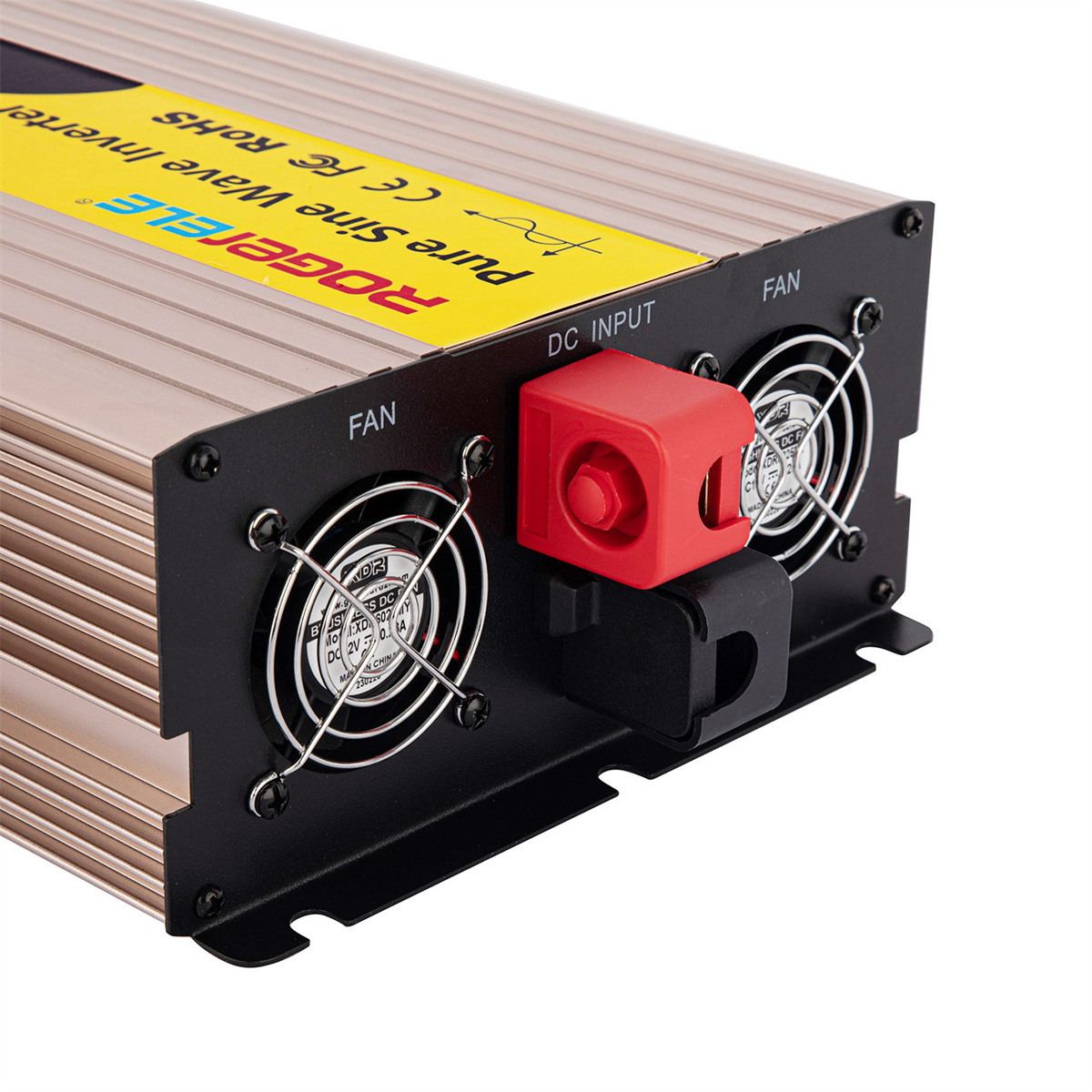 Choose the REP2000 pure sine wave inverter for mid-size 4 to 5 qt fryers near 1,400 to 1,500W, full-size or dual-basket units up to about 1,800W, or any cook that shares the inverter with other AC loads. The REP2000-121 is rated 2000W continuous / 4000W peak, same pure sine and efficiency pattern (up to 90% on 12V), no-load under 0.9A, size 355 × 205 × 95 mm and weight 3.9 kg, with the same 10.5V/10V alarm/cutoff and USB QC3.0 on 12/24V. Full-load draw is about 185A at 12V. Eighty percent of 2000W is about 1,600W. A 24V REP model halves cable current if the RV already has a 24V house bank.
REP1500-121 vs REP2000-121 specifications
| Specification | REP1500-121 | REP2000-121 |
|---|---|---|
| Rated / peak output | 1500W / 3000W | 2000W / 4000W |
| Waveform / THD | Pure sine, <3% linear load | Pure sine, <3% linear load |
| DC input / operating range | 12V / 10 to 15.5V | 12V / 10 to 15.5V |
| Max efficiency (12 / 24 / 48V) | 90% / 92% / 95% | 90% / 92% / 95% |
| No-load current (12V) | <0.8A | <0.9A |
| Low-voltage alarm / cutoff | 10.5V / 10V | 10.5V / 10V |
| Approx. battery current at full load | about 139A | about 185A |
| Size / net weight | 310 × 180 × 80 mm / 2.9 kg | 355 × 205 × 95 mm / 3.9 kg |
| USB | QC3.0 on 12/24V models | QC3.0 on 12/24V models |
| Best air fryer match | Compact 900 to 1,200W travel units, alone | Mid to full-size 1,400 to 1,800W, or shared AC loads |
Battery, wiring and a related kettle guide
Cook time drains the bank. A 1,500W fryer running the heater about 70% of a 30-minute cycle uses about 525Wh at the fryer, or roughly 580Wh from the battery (~45Ah at 12.8V LiFePO4). A 12V 100Ah pack covers about two such cooks; daily cooking is happier on 200Ah+. The BMS must deliver ~140A continuous for 1500W full load or ~185A for 2000W — a 100Ah battery with a 100A BMS supports only about 1,100W. Lead-acid packs sag quickly at these currents. The REP series has no built-in charger, so plan DC-DC, solar or shore refill. Use short heavy cables with a fuse near the battery sized for full-load current, mount in a dry ventilated space, and bond ground to the chassis per the manual. Kettles raise a similar continuous-heat question; see electric kettle inverter size: 1500W vs 2000W in an RV.
FAQ
Can a 1500W inverter run a 1500W air fryer?
Ratings match on paper, but there is no headroom for other loads or battery sag over 20 to 40 minutes. Prefer ≤1,200W on a 1500W inverter, or move to 2000W for a ~1,500W label.
Do air fryers need pure sine wave?
Most will heat on a modified waveform, but timers, fans and controls run quieter on pure sine. REP models are pure sine with THD under 3% on a linear load.
Why does the inverter trip halfway through cooking?
Usually voltage sag, undersized cables, or a BMS current limit — not a huge start-up surge. Check cables, state of charge and shared loads.
Is a dual-basket air fryer OK on 2000W?
Many draw 1,500 to 1,800W. That fits 2000W if other AC loads stay off and you stay near ~1,600W (80%). Confirm the label; some dual units exceed 2000W.
Should I run the generator or engine while frying?
Shore power or a generator removes the battery-current problem. Idling helps a little, but a stock alternator rarely supplies 140 to 185A at idle — treat it as top-up, not the main source.
Conclusion
For a compact 900 to 1,200W travel air fryer used alone in an RV, a 1500W pure sine inverter is enough under about 80% continuous load. For mid/full-size fryers at 1,400 to 1,800W, or shared AC loads, choose 2000W so a 20 to 40 minute cook finishes with margin. Plan for roughly 140 to 185A at 12V, a LiFePO4 BMS that can deliver it, and short fused cables — or move to 24V for daily cooking. Compare the REP1500 pure sine wave inverter and the REP2000 pure sine wave inverter. For quotes, OEM options or custom DC voltages from Wenzhou Rogerele Electronic Technology Co., Ltd., contact us.
