
Food Truck Inverter Size: 3000W vs 5000W for a 120V Kitchen
Date:2026-10-10 Click:25 Source:Rogerele
Quick answer: A typical 120V food truck with a prep fridge, a freezer, lights, a POS system, an exhaust fan, a blender and a small espresso machine can peak at about 3,800W when several of them run together. A 3000W pure sine wave inverter works only if you never run the blender and the espresso machine at the same time. A 5000W inverter on a 48V or 24V lithium battery bank of about 8 to 10kWh covers a full day of service with headroom. Keep griddles and fryers on propane.
Many food truck owners want to stop running a noisy generator during service. Some markets and event venues limit generator noise and fumes, and customers notice them too. The problem is that a kitchen on wheels mixes motor loads, heating loads and electronics, and the wrong inverter size or battery voltage leads to trips in the middle of the lunch rush. This guide sizes the inverter and battery step by step.
List every 120V load in the truck
Start with the nameplate of each appliance. If the label shows amps, multiply by 120 to get watts. The planning figures below are typical ranges. Your own labels are the numbers that count.
| Load | Typical running watts | Use during a 10-hour day | Approx. daily energy |
|---|---|---|---|
| Prep / reach-in fridge | 200 to 400W (compressor cycles) | about 120W average x 10h | 1.2kWh |
| Chest freezer | 100 to 200W | about 60W average x 10h | 0.6kWh |
| LED lights and menu board | 80 to 150W | 120W x 8h | 0.96kWh |
| POS tablet, card reader, router | 30 to 60W | 50W x 8h | 0.4kWh |
| Exhaust or ventilation fan | 150 to 350W | 250W x 6h | 1.5kWh |
| Commercial blender | 1,000 to 1,500W | 1,500W x 0.5h total | 0.75kWh |
| Small espresso machine | 1,200 to 1,500W | 1,400W x 1.5h of heating | 2.1kWh |
| Total | about 3,800W if all run at once | about 7.5kWh |
Two numbers come out of this list: the peak watts (what the inverter must deliver at one moment) and the daily kWh (what the battery must store).
How to pick the inverter size
Add the loads that really overlap
In the example, the fridge, freezer, lights, POS and fan run all the time, about 870W. Add the espresso machine (1,400W) and the blender (1,500W) at the same moment and you reach about 3,770W. That is above a 3000W rating. If staff can stagger the two big loads, the peak drops to about 2,370W and a 3000W unit fits with margin. If they cannot, choose 5000W.
Leave room for compressor starts
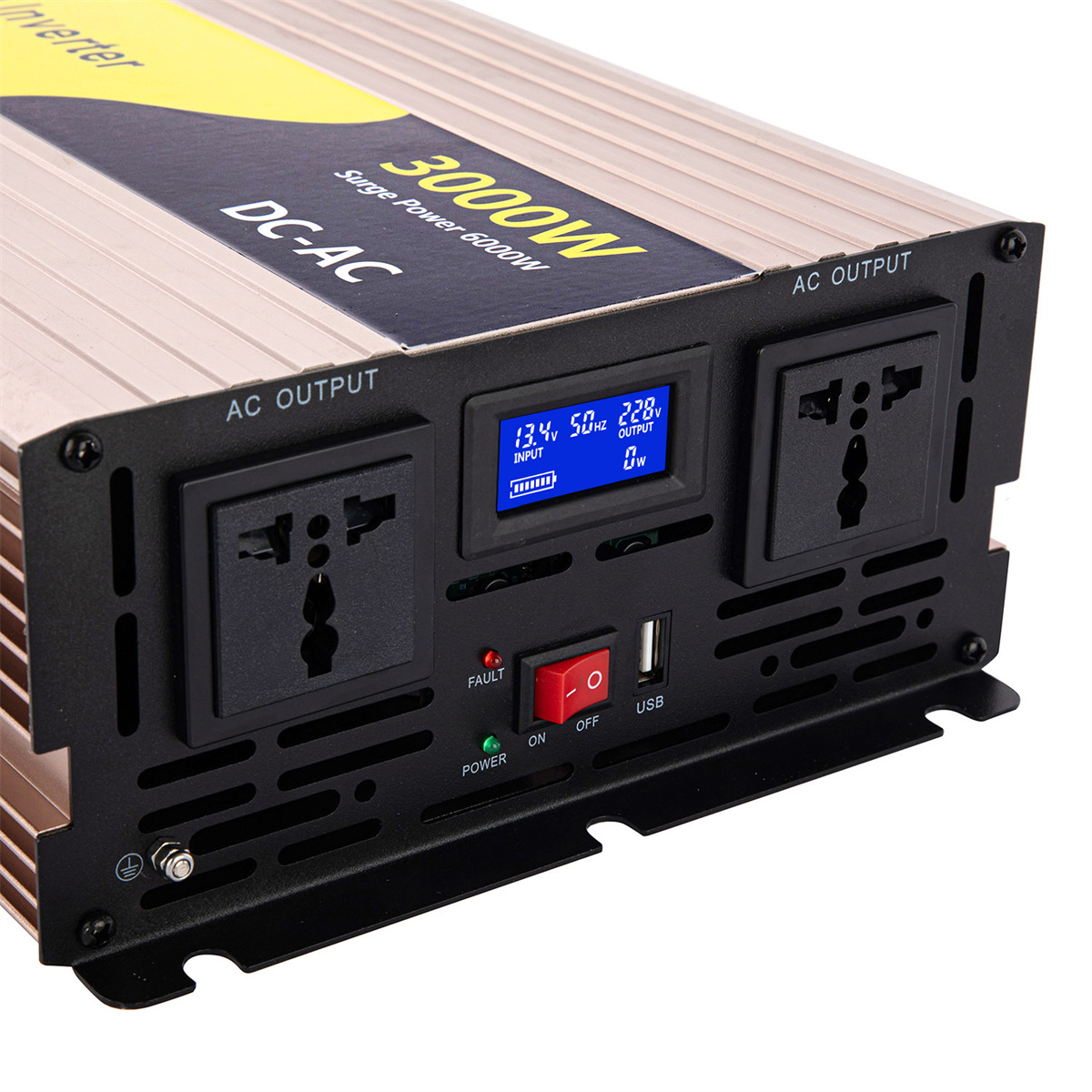
Fridge and freezer compressors draw several times their running current for a moment at start-up. Our REP3000 pure sine wave inverter lists 3000W rated and 6000W peak output, but the product page states that the peak duration is not specified. Size on the continuous rating and keep about 20 to 25% spare. A pure sine wave with THD below 3% (linear load) also suits compressor motors and the electronics in POS systems and espresso controllers.
Leave cooking heat to propane
Electric griddles, fryers and ovens often draw 3,000W to 6,000W each, sometimes for hours. Running them from batteries takes an inverter and battery bank far larger than most trucks can carry. Most battery-powered food trucks keep cooking on propane and use the inverter for refrigeration, drinks, ventilation and electronics.
Why 48V or 24V is better than 12V in a food truck
DC current = AC watts ÷ battery voltage ÷ efficiency. The REP3000 and REP5000 list maximum efficiencies of 90% at 12V, 92% at 24V and 95% at 48V. For the 3,770W example peak:
- 12V: about 349A
- 24V: about 171A
- 48V: about 83A
At 12V that current needs very heavy cables and large fuses, and voltage drop can reach the 12V low-voltage alarm (10.5V ±0.5V) during a blender start. At 48V the same load draws less than a quarter of the current. For a 5000W system, 48V is the practical choice, and 24V is acceptable with short cable runs. Our guide on how to install a car power inverter: wire size and fuse explains how to size cables and fuses for these currents.
How much battery for a full day of service?
Add about 8 to 10% for inverter losses: 7.5kWh becomes about 8.2kWh. The REP5000 48V model also lists a no-load current below 0.5A, about 24W, or roughly 0.3kWh over 12 hours if the inverter is left on all day.
- 48V system: 8.2kWh ÷ 51.2V ≈ 160Ah, so a 48V 200Ah LiFePO4 bank (about 10kWh) leaves reserve.
- 24V system: 8.2kWh ÷ 25.6V ≈ 320Ah, so plan about 400Ah of 24V LiFePO4.
- 12V system: about 640Ah. That is possible but heavy and hard to charge.
The REP series is a DC-to-AC inverter. The product page does not list battery charging or automatic transfer, so recharging needs a separate charger on shore power, solar or an alternator charger. Ask a qualified electrician to install a transfer switch if you also connect shore power or a generator.
REP3000 vs REP5000 for a food truck
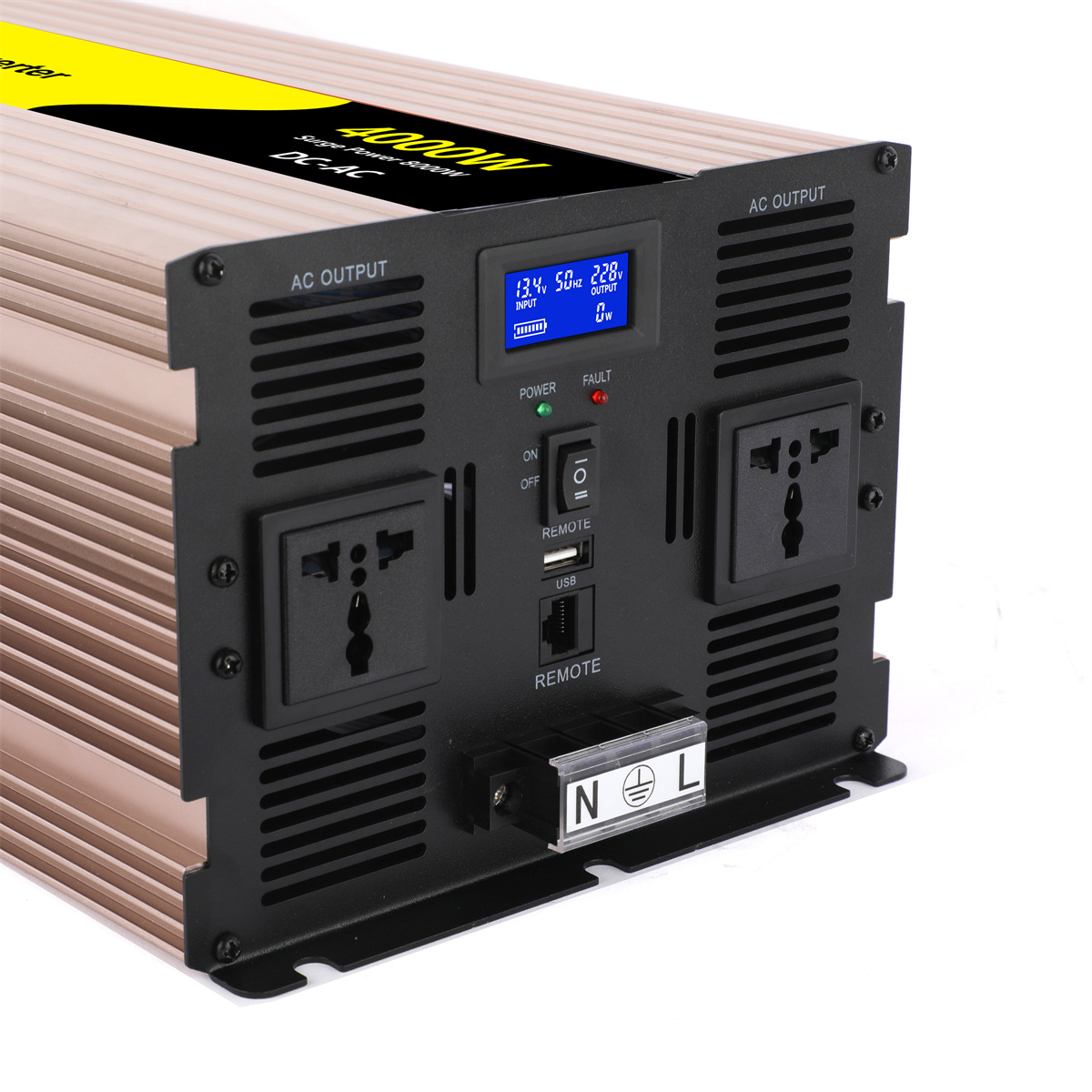
The REP5000 pure sine wave inverter is the one to choose when the espresso machine, blender and refrigeration must run together. The REP3000 suits smaller menus, such as coffee carts or ice cream trucks. Specifications from the product pages:
| Specification | REP3000 | REP5000 |
|---|---|---|
| Rated / peak output | 3000W / 6000W | 5000W / 10000W |
| DC input versions | 12V / 24V / 48V | 12V / 24V / 48V |
| AC output (ordering options) | 100/110/120V or 220/230/240V, 50Hz or 60Hz | 100/110/120V or 220/230/240V, 50Hz or 60Hz |
| Max efficiency 12V / 24V / 48V | 90% / 92% / 95% | 90% / 92% / 95% |
| No-load current 12V / 24V / 48V | <1A / <0.7A / <0.4A | <1.2A / <0.8A / <0.5A |
| Operating temperature | −10°C to +50°C | −10°C to +50°C |
| Dimensions / net weight | 415 × 205 × 95 mm / 4.95 kg | 475 × 205 × 152 mm / 8.54 kg |
| Best fit | Coffee cart, ice cream truck, staggered loads | Full menu, about 3,800W peaks |
Mind the 50°C operating limit. Mount the inverter away from the cooking line, in a ventilated compartment with clear space around the cooling fan, and keep grease and water away from it. A US truck uses the 120V 60Hz version. Note that the REP series has a single AC output, so appliances that need 240V split-phase need a different setup.
FAQ
Can a 3000W inverter run a food truck?
Yes, for refrigeration, lights, POS, a fan and one 1,500W appliance at a time. Two 1,500W appliances on top of the base load will overload it.
Can I run a fryer or griddle on an inverter?
Only with a very large battery. A 3,000W fryer running for 4 hours uses about 12kWh, more than the rest of the truck combined. Propane is the practical choice.
Should a food truck use 12V, 24V or 48V?
48V for 5000W systems, and 24V at minimum for 3000W. Lower current means thinner cables and less voltage drop.
Why pure sine wave instead of modified sine?
Compressors, fan motors and digital controls run cooler and more reliably on a clean sine wave.
Conclusion
Size a food truck inverter from the loads that really overlap, not from a single appliance. For about 3,800W peaks and 7.5kWh a day, a 5000W pure sine inverter on a 48V lithium bank of about 10kWh is a solid setup. With disciplined staggering, a 3000W unit on 24V or 48V is enough for smaller menus. Keep heat-based cooking on propane.
See full specifications and model codes on the REP5000 pure sine wave inverter page. For help matching an inverter to your food truck loads, or for distributor and OEM orders, contact us: email Long@rogerele.com, Tel +86-577-62769701, WhatsApp +86-13587757588.
