
Can an Inverter Charger Work as a UPS for a Computer and Home Office?
Date:2026-10-10 Click:30 Source:Rogerele
Quick answer: Yes. A pure sine wave inverter with charger, such as the Rogerele REPU series, can act as a battery UPS for a desktop computer, monitor, Wi-Fi router and modem. While grid power is present it passes AC through to your devices and charges the battery; when the grid fails it switches to battery power. For a typical home office load of 250–400W, a REPU-1000 on a 12V 100Ah lithium battery gives roughly three to four hours. Ask for the transfer time of the exact model if you run a sensitive PC or server.
Small plug-in UPS boxes are made to give you five or ten minutes to save your work. Many people who work from home now want hours instead: enough to finish a video call, keep the internet up, and keep working through a long outage. That is where an inverter charger and a real battery bank make sense.
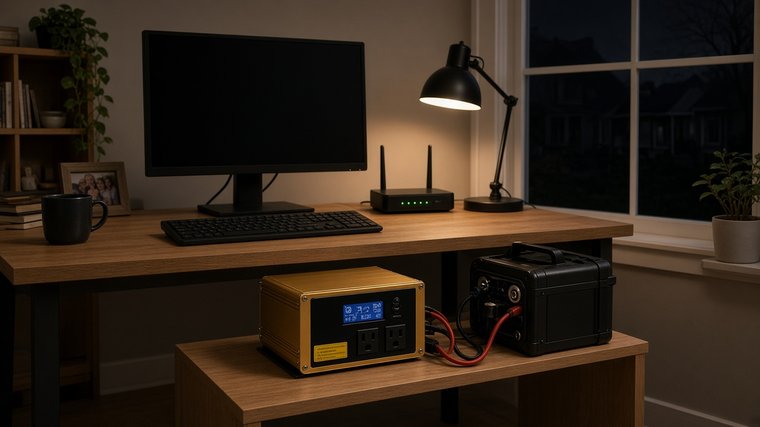
How does an inverter with charger work as a UPS?
An inverter charger combines three jobs in one box: a battery charger, a pure sine wave inverter and an automatic transfer switch. In normal operation, utility power feeds your devices directly while the built-in charger keeps the battery full. When the AC input disappears, the unit switches the outlets to the inverter, which turns battery DC into 110V/120V or 220V/230V/240V AC. When grid power comes back, it switches back and starts recharging the battery.
The difference from a small desktop UPS is scale. A desktop UPS has a small sealed battery inside. An inverter charger connects to an external 12V, 24V or 48V battery bank that you size yourself, so runtime is limited only by the battery you choose.
Does transfer time matter for a computer?
Transfer time is the short gap between the grid failing and the inverter taking over. Standby and line-interactive UPS designs usually switch in a few milliseconds to about 10 ms. Many desktop computer power supplies are designed to ride through a gap of around 16 ms at their rated load, so a fast switch normally goes unnoticed. Laptops are not affected at all, because their own battery covers the gap.
Two practical tips: keep the computer's load well below its power supply rating so it has more hold-up margin, and test the setup once by switching off the mains breaker while the PC is running something unimportant. If your application can't tolerate any interruption, such as a file server, ask us for the transfer specification of the model you plan to buy before ordering.
How many watts does a home office use?
Add up the nameplate or measured watts of everything that must stay on. A plug-in power meter gives the most accurate numbers. Typical values look like this:
| Device | Typical running watts |
|---|---|
| Desktop PC (office work) | 80–200W |
| Gaming or workstation PC under load | 300–600W |
| Laptop with charger | 45–100W |
| 24–27 inch monitor | 20–40W each |
| Wi-Fi router plus modem or ONT | 15–30W |
| LED desk lamp | 8–12W |
| Laser printer (while printing) | 400–800W peaks |
A normal setup of one desktop, two monitors, the router and a lamp lands around 250–400W. Leave the laser printer off the backup circuit, because its fuser heater pulls short, heavy peaks that waste battery.
Which Rogerele inverter charger size should I choose?
Pick a model whose rated continuous power is at least 1.5 times your total load. That leaves room for start-up peaks and keeps the inverter running cool. All three models below are pure sine wave (THD under 3% on linear loads) and are offered in 12V, 24V and 48V input with 50Hz or 60Hz output, according to their product pages.
| Model | Rated / peak power | Charging current (12V / 24V / 48V) | Good fit for |
|---|---|---|---|
| REPU-1000 | 1000W / 2000W | 20A / 10A / 5A | One PC, monitors, router, lights |
| REPU-2000 | 2000W / 4000W | 30A / 20A / 10A | Two workstations or office plus fridge |
| REPU-3000 | 3000W / 6000W | 30A / 20A / 10A | Small office, NAS, lights and kitchen loads |
The full range, including smaller and larger units, is listed in our pure sine wave inverter with charger (UPS) category.
How long will the battery keep my office running?
Use this simple estimate: runtime in hours = battery watt-hours × usable fraction × inverter efficiency ÷ load watts.
Example with a 12V lithium battery
A 12.8V 100Ah LiFePO4 battery stores about 1,280Wh. Using about 90% of it with an inverter efficiency of roughly 90% gives about 1,040Wh of AC energy. At a 300W office load, that is about 3.5 hours. At 150W (laptop, monitor and router), it is closer to 7 hours. The REPU-1000's 12V no-load current is listed at under 0.4A, so the idle draw is small.
Recharge time after the outage
The REPU-1000 charges a 12V bank at up to 20A, so refilling 100Ah takes around five to six hours once the grid returns. The REPU-2000 and REPU-3000 charge at up to 30A on 12V. For bigger banks, choose 24V or 48V to keep cable currents down. Our battery runtime guide and LiFePO4 vs lead-acid comparison go deeper.
How should I connect it safely?
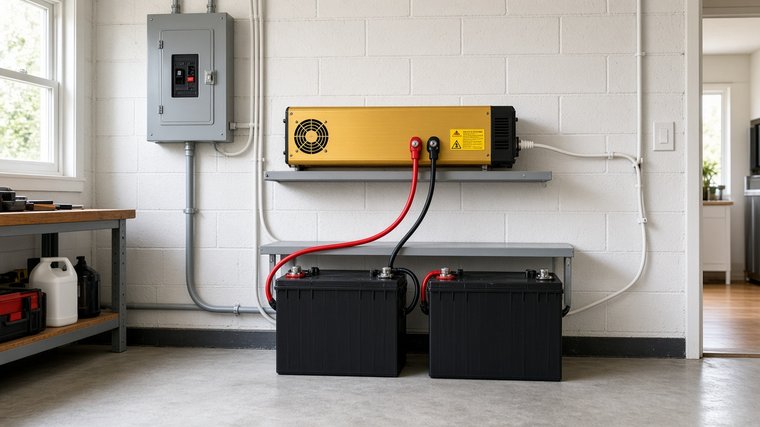
- Plug the inverter charger's AC input into a wall outlet, and plug your computer, monitor and router into its AC outlets. Do not back-feed a house circuit; see our house wiring guide.
- Use short, thick battery cables and a DC fuse close to the battery positive terminal.
- Set the charger to suit your battery type, and keep the unit ventilated, since it uses air cooling.
- Order the output voltage and frequency for your country, for example 120V 60Hz for the USA.
If you are deciding between a UPS inverter and a solar hybrid system, read UPS vs hybrid inverter for home energy storage.
FAQ
Is an inverter charger better than a normal computer UPS?
For short outages a small UPS is fine. For outages of an hour or more, an inverter charger with an external battery gives much longer runtime and a pure sine output that suits PCs with active-PFC power supplies.
Will my PC restart when the power fails?
With a fast transfer and a power supply that is not overloaded, a desktop normally keeps running. Test once to be sure, and ask us for the transfer specification if zero interruption is critical.
Can I use a modified sine wave inverter for a computer?
We don't recommend it. Pure sine output matches grid power, so power supplies, monitors and chargers run cooler and quieter.
What battery voltage should I choose?
12V is simple for 1000W loads. For 2000W and above, or large battery banks, 24V or 48V keeps current and cable size manageable.
Do you supply OEM or bulk orders?
Yes. Rogerele manufactures pure sine wave inverters and inverter chargers for distributors and brands. Contact us with your voltage, frequency, power and quantity for a quotation.
