
RV Fridge Inverter Size: 1000W vs 2000W
Date:2026-10-15 Click:31 Source:Rogerele
Quick answer: For a typical RV AC compressor fridge (about 100–200W running, with a short 3–7× startup surge), a 1000W pure sine inverter is usually enough if the fridge is the main continuous load and you hardwire the DC side. Choose a 2000W unit when you also run a microwave, coffee maker, or other high-watt tools on the same inverter, or when several surge loads can stack. Pure sine protects compressor electronics. A separate DC 12V compressor fridge often averages only 30–60W and may not need an inverter at all.
Camping and RV boondocking share one question: how much inverter keeps the fridge cold without draining the battery or tripping on compressor start? The answer depends on fridge type, running watts, surge, shared AC loads, and 12V vs truck/RV house banks.
AC compressor fridge vs DC fridge vs absorption
Most residential-style RV fridges that plug into 120V AC use a sealed compressor. Industry-typical labels show roughly 100–200W while the compressor runs. Startup can briefly pull about 3 to 7 times running watts for a few seconds—so a 150W fridge might spike near 450–1050W. That surge is why continuous rating alone is not enough; peak capability matters.
A dedicated 12V DC compressor fridge (common in overlanding) often averages about 30–60W and connects straight to the battery with a fuse—no inverter required for the fridge itself. Absorption (three-way) fridges can run on propane or AC heating elements and behave differently from compressor loads; this article focuses on AC compressor fridges sized against a pure sine inverter.
Why pure sine for a fridge compressor
Compressor electronics and variable-speed boards expect a clean sine wave. Pure sine with THD under 3% on a linear load keeps the motor cooler and quieter than a stepped square-wave output. For car, truck and RV fridge duty, size a pure sine inverter so continuous watts cover running load plus headroom, and peak watts cover the compressor start.
When a 1000W inverter is enough
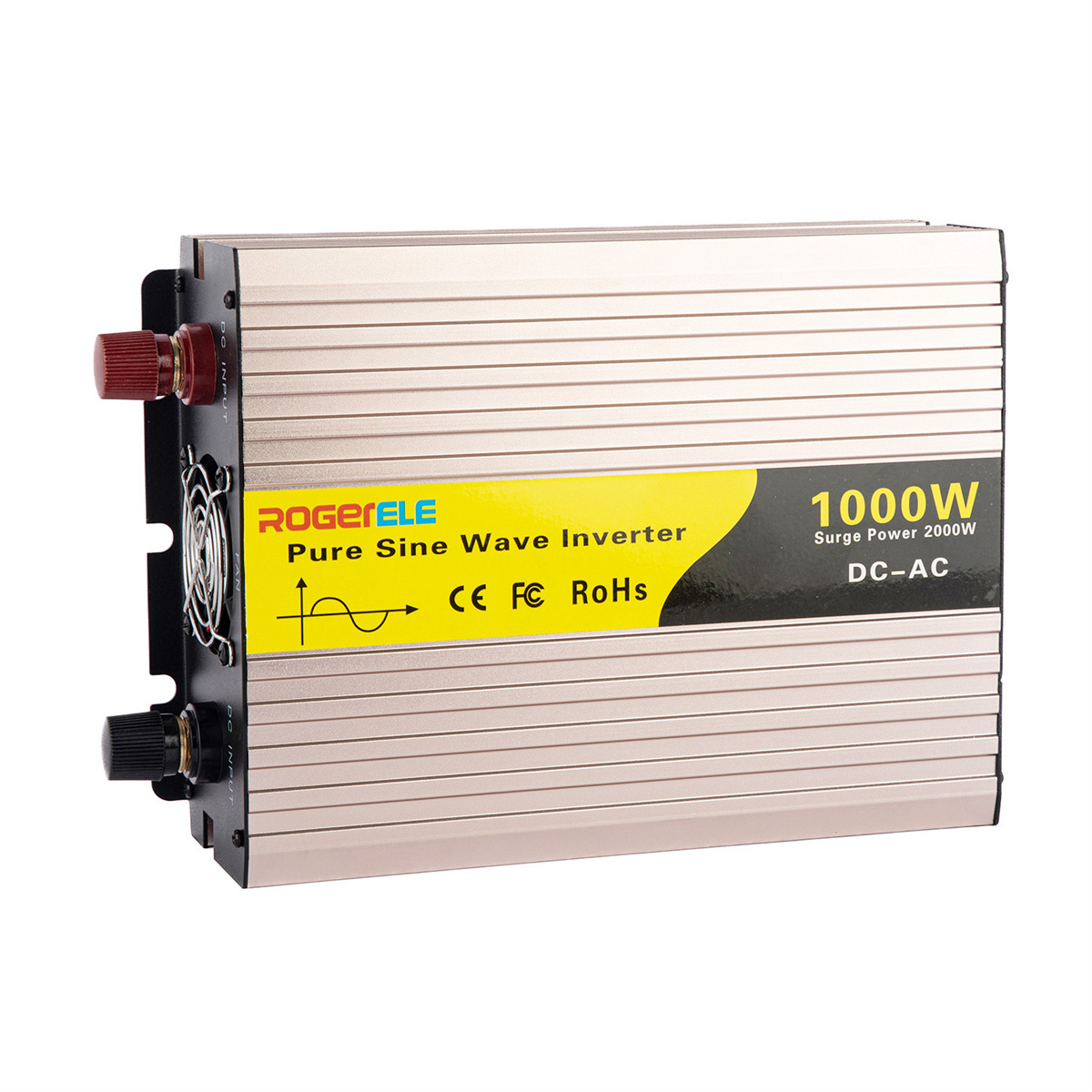 If the fridge is the main AC load—say 120–180W running and under about 1000W surge—and you are not planning to run a microwave or induction plate on the same inverter at the same time, 1000W continuous with 2000W peak is a practical fit for many car-camping and light RV setups.
The REP1000 pure sine wave inverter lists 1000W continuous / 2000W peak, pure sine THD <3% on a linear load, 275 × 180 × 80 mm and 2.5 kg. It is available in 12V, 24V and 48V DC versions with 100/110/120V or 220/230/240V AC output. Listed maximum efficiency is 90% / 91% / 93% on 12 / 24 / 48V; no-load current is under 0.4A / 0.3A / 0.2A. On 12V the input window is 10–15.5V, with low-voltage alarm / cutoff / recovery at 10.5±0.5 / 10±0.5 / 12.3±0.5 V. QC3.0 USB is included on 12V and 24V versions, with a listed 2-year warranty.
Hardwire for fridge current, not the cigarette lighter
At ~90% inverter efficiency, a 150W fridge draws about 150 ÷ (12 × 0.9) ≈ 14A from a 12V bank while running—manageable—but a 700–1000W surge briefly needs far more. Accessory sockets and thin factory wiring are not built for inverter surge. Hardwire to the battery with a fuse near the positive terminal, keep the DC run short, and size cable for continuous current plus margin. For microwave-class loads on the same bus, see what size inverter for a microwave in a truck or RV.
When 2000W is the safer pick
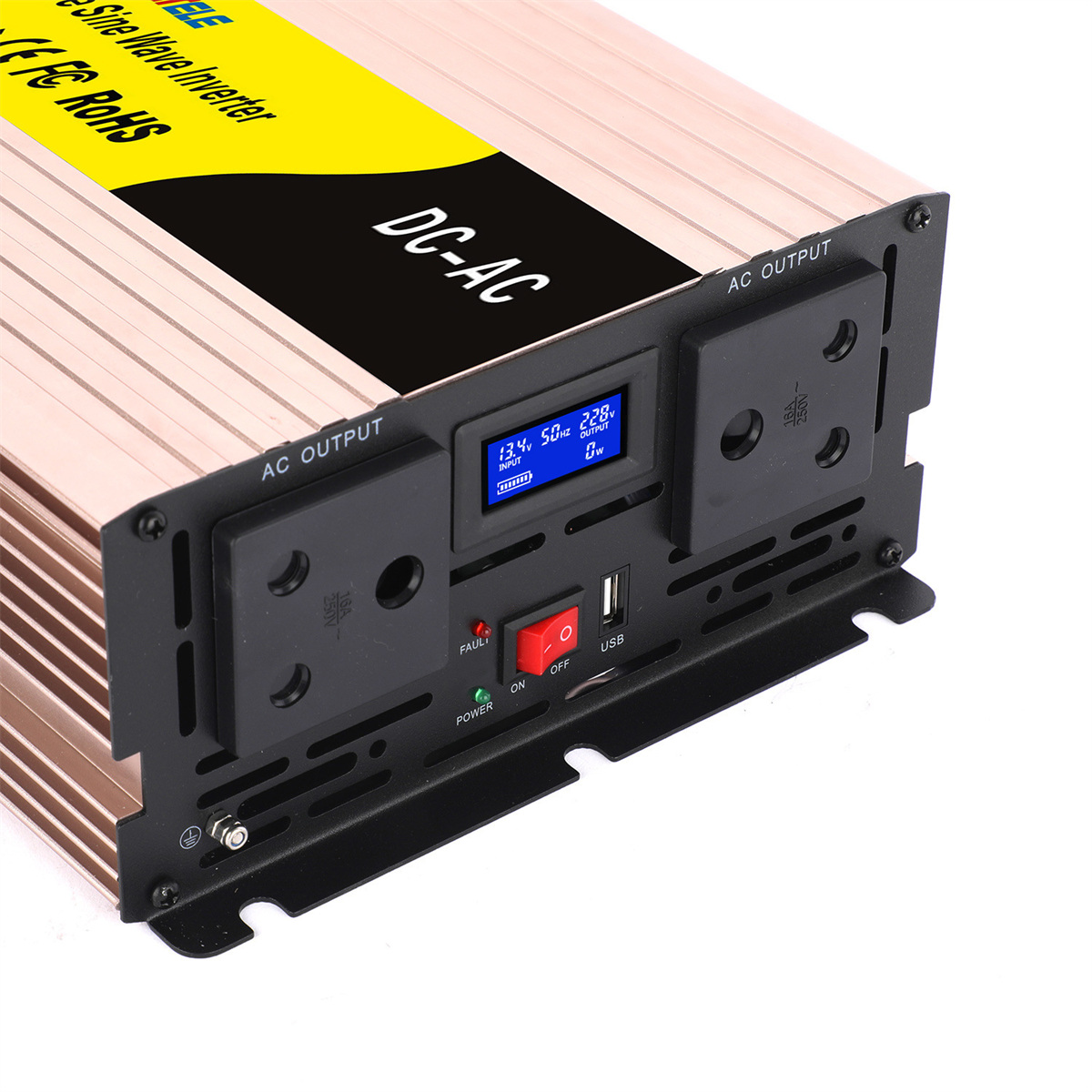 Step up to 2000W continuous when the fridge shares the inverter with other appliances: a 700–1200W microwave, a coffee maker, a small power tool, or an AC charger that can overlap the compressor start. Two surge events stacked for a second can trip a 1000W unit even if each load alone looks fine on paper.
The REP2000 pure sine wave inverter lists 2000W continuous / 4000W peak, pure sine THD <3%, 355 × 205 × 95 mm and 3.9 kg. DC versions are 12 / 24 / 48V with the same AC voltage options. Listed maximum efficiency is 90% / 92% / 95%; no-load current is under 0.9A / 0.5A / 0.3A. On 24V the input window is 20–31V, with LVA / cutoff / recovery at 21±0.5 / 20±0.5 / 24±0.5 V. QC3.0 USB is on 12V and 24V versions, with a listed 2-year warranty. At 2000W and ~90% efficiency, expect about 185A from 12V or about 93A from 24V—hardwire with heavy cable is mandatory.
Typical fridge load and battery runtime (approx.)
These figures are industry-typical estimates, not Rogerele lab measurements. Use your fridge nameplate and a clamp meter when you can.
| Load scenario (approx.) | Running watts | Likely surge | Suggested continuous inverter |
|---|---|---|---|
| Small AC compressor fridge alone | 100–150W | ~300–900W | 1000W often enough |
| Mid AC RV fridge alone | 150–200W | ~450–1200W | 1000W if surge <2000W peak; else 2000W |
| Fridge + microwave (not simultaneous ideal) | Fridge 150W + microwave 700–1200W | Can stack | 2000W preferred |
| DC 12V compressor fridge | ~30–60W average | Low | Usually no inverter for the fridge |
Runtime math at ~90% inverter efficiency: DC watts ≈ AC watts ÷ 0.9. A fridge that averages 80W AC (duty cycle included) pulls about 89W from the battery. From usable capacity at 12V (for example half of a 100Ah lead-acid bank ≈ 50Ah, or more with lithium—adjust to your chemistry):
- Approx. DC draw: 89W ÷ 12V ≈ 7.4A average
- From 50Ah usable at 12V: 50 ÷ 7.4 ≈ 6.8 hours of average fridge runtime
- On 24V the same 89W is about 3.7A, with less cable voltage drop on long RV runs
Always leave headroom for other DC loads (lights, fans, CPAP) and for cold ambient starts when the compressor runs longer.
REP1000 vs REP2000 for fridge duty
| Item | REP1000 | REP2000 |
|---|---|---|
| Continuous / peak | 1000W / 2000W | 2000W / 4000W |
| Waveform / THD (linear) | Pure sine / <3% | Pure sine / <3% |
| DC versions | 12 / 24 / 48V | 12 / 24 / 48V |
| AC output options | 100/110/120 or 220/230/240V | 100/110/120 or 220/230/240V |
| Size / net weight | 275 × 180 × 80 mm / 2.5 kg | 355 × 205 × 95 mm / 3.9 kg |
| Max efficiency 12 / 24 / 48V | 90% / 91% / 93% | 90% / 92% / 95% |
| No-load 12 / 24 / 48V | <0.4A / <0.3A / <0.2A | <0.9A / <0.5A / <0.3A |
| 12V LVA / cutoff / recovery | 10.5±0.5 / 10±0.5 / 12.3±0.5 V | (order matching DC version) |
| 24V LVA / cutoff / recovery | (order matching DC version) | 21±0.5 / 20±0.5 / 24±0.5 V |
| QC3.0 USB | On 12V and 24V | On 12V and 24V |
| Listed warranty | 2 years | 2 years |
| Best fridge fit | Fridge as main AC load; limited extras | Fridge + microwave/tools; higher surge margin |
Car, truck and RV wiring notes
Passenger cars and light pickups are usually 12V: a fridge-only 1000W inverter hardwired near the battery works for weekend camping if the battery state of charge allows it. Heavy trucks and large RVs may use 24V house banks—order the matching DC version. Keep cabinet ventilation clear; sealed heat shortens life.
FAQ
Will a 1000W inverter start my RV fridge?
Often yes if running watts are about 100–200W and surge stays under the 2000W peak. If LRA is higher or other loads share the inverter, choose 2000W.
Do I need an inverter for a 12V DC fridge?
Usually no. A DC compressor fridge wires to the battery (fused) and typically averages about 30–60W. Use an inverter only for separate AC appliances.
Can I run fridge and microwave together?
Plan for 2000W continuous. A 1000W unit may handle either alone but can trip when the microwave starts while the compressor is already drawing surge current.
12V or 24V for a fridge inverter?
Match the house bank. Fridge running current is modest, but 2000W-class shared loads favor 24V to cut DC amps roughly in half and reduce cable drop on long RV runs.
What AC voltage should a US RV use?
Order the 100/110/120V version so the fridge and other North American appliances see the expected voltage.
Conclusion
Size for the compressor surge first, then for everything else on the same AC bus. A typical AC RV fridge alone often fits a 1000W / 2000W-peak pure sine inverter; add microwave or stacked surges and move to 2000W / 4000W peak. Prefer pure sine, hardwire the DC side, and match 12V or 24V to the battery bank. DC compressor fridges usually skip the inverter entirely.
See full specifications on the REP1000 pure sine wave inverter and REP2000 pure sine wave inverter pages. For help sizing a fridge inverter for a car, truck or RV build, contact us: email Long@rogerele.com, Tel +86-577-62769701, WhatsApp +86-13587757588.
