
What Size Inverter Do You Need for a CPAP in an RV?
Date:2026-10-20 Click:30
Short answer: a 300W pure sine wave inverter runs any single CPAP machine — even with a heated humidifier — and a 500W model is only needed when the CPAP shares power with a laptop, TV or a second CPAP. A typical CPAP draws 20–40W without heated humidity and about 53W with it, peaking near 104W. The inverter is rarely the problem; the battery is. Budget roughly 300Wh per night without a humidifier and 500Wh with one, or the machine stops before you wake up. This guide from Wenzhou Rogerele Electronic Technology Co., Ltd. shows the maths.
How Many Watts Does a CPAP Use?
CPAP power draw depends less on pressure setting than on heating. The blower itself is a small load; the heated humidifier and heated tube are what push the watts up.
| CPAP setup | Typical draw | Peak draw | Notes |
|---|---|---|---|
| CPAP only, no humidifier | 20–40W | About 60W | Lowest battery use |
| CPAP + heated humidifier | About 53W typical | 104W peak | Manufacturer figures for a popular 90W-supply model |
| CPAP + humidifier + heated tube | 60–90W | About 104W | Highest comfort, highest battery cost |
| Phone charging / small fan | 10–30W extra | — | Often forgotten in the night budget |
Read your own machine's power supply label. Many CPAP supplies are rated 90W, which already tells you the ceiling: a 300W inverter has more than three times that capacity, and its 600W peak covers the 104W maximum easily.
What Size Inverter Do You Need for a CPAP?
| Night-time setup | Total typical load | Recommended inverter |
|---|---|---|
| One CPAP, no humidifier | 20–40W | 300W |
| One CPAP with heated humidifier | 53–90W | 300W |
| CPAP + laptop + phone charging | 120–180W | 300–500W |
| CPAP + TV + fan in the evening | 150–220W | 500W |
| Two CPAPs (couple sharing one system) | 110–200W | 500W |
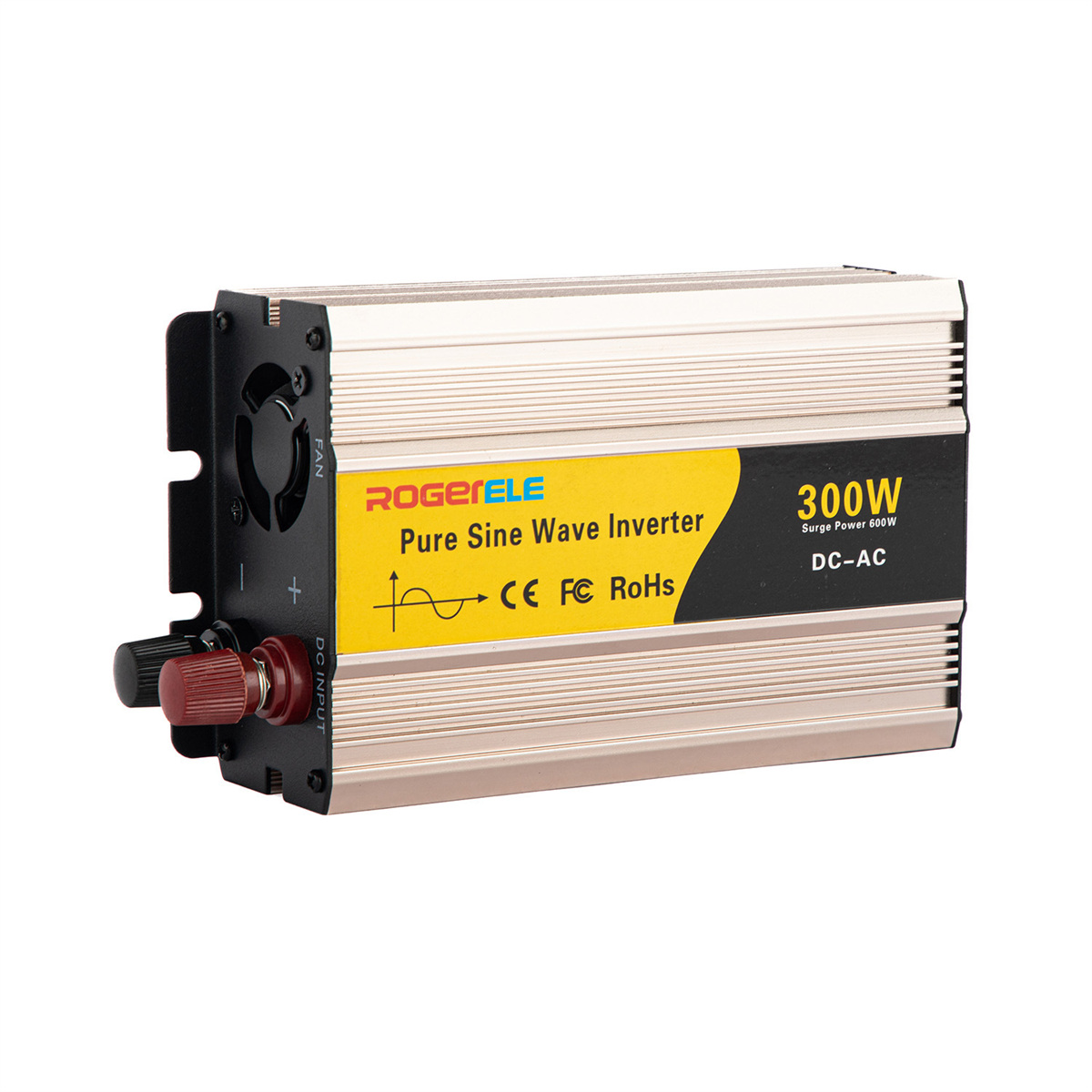
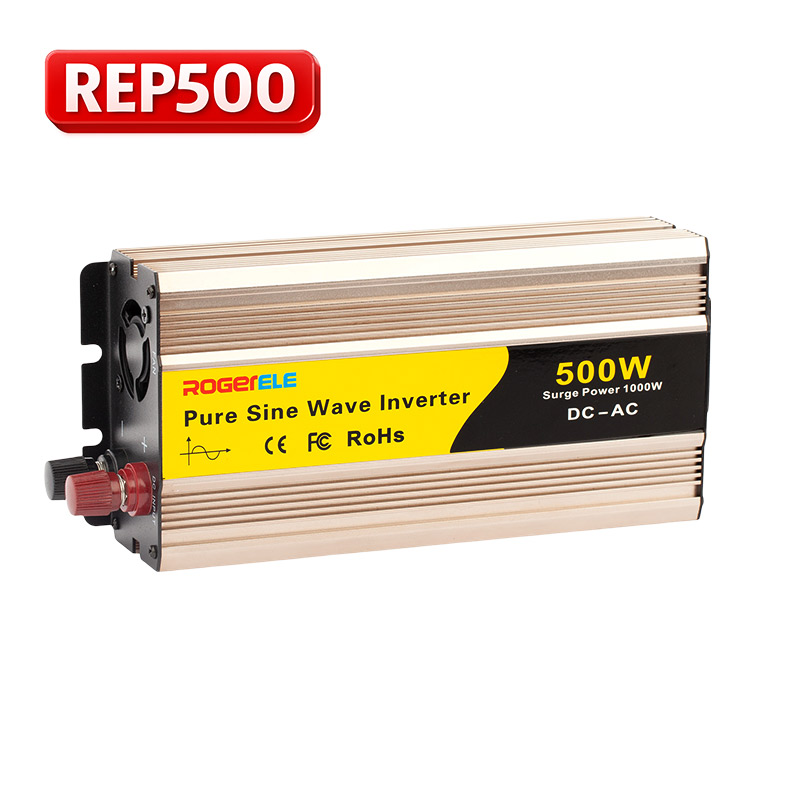
For a single CPAP, the ROGERELE REP300 (300W rated, 600W peak) is the efficient choice — its 12V version draws under 0.3A at no load, which matters when the inverter stays on for eight hours. Choose the REP500 (500W rated, 1000W peak) when the CPAP is one of several night-time loads, so everything together stays under about 60% of the rating.
Why Must the Inverter Be Pure Sine Wave?
A CPAP is a medical device with a switch-mode power supply, and its heated humidifier is a controlled heating circuit. Pure sine wave power is the same waveform the machine was designed for at home, so the supply runs cool and the therapy stays stable all night. The ROGERELE REP series outputs pure sine wave with THD below 3% under a linear load. Modified sine wave units are the false economy here: they can make supplies buzz or run hot, and CPAP manufacturers design and test against clean mains power. For a device you breathe through for eight hours, pure sine wave is not an upgrade — it is the baseline.
Inverter or DC Converter: Which Is Better for CPAP?
Honest answer: a model-specific DC converter is slightly more efficient, because it skips the DC-to-AC-to-DC double conversion and can save roughly 10% of battery per night. An inverter is the better choice when:
- You also need AC at night — a laptop, a TV, a fan or a partner's CPAP on the same system.
- You change machines or travel in different vehicles and do not want a converter tied to one model.
- Your setup already has an inverter for daytime loads, so one system covers everything.
Either way, never run a CPAP from an inverter powered by the starter battery in a vehicle you need to start in the morning. Use the auxiliary battery.
How Much Battery Does a CPAP Need for a Full Night?
Use this formula: Night energy (Wh) ≈ 8 hours × (CPAP watts ÷ inverter efficiency + inverter idle watts).
| Setup (8 hours) | Battery energy per night | Nights on a 100Ah LiFePO4 (about 1,024Wh usable) |
|---|---|---|
| CPAP only at 30W, REP300 at up to 90% efficiency | About 300Wh | About 3 nights |
| CPAP + humidifier at 53W | About 500Wh | About 2 nights |
| Two CPAPs with humidifiers at about 110W total | About 1,000Wh | About 1 night |
Three ways to stretch the battery: turn the heated humidifier and heated tube off or down (the single biggest saving), keep the inverter small so idle draw stays low, and recharge daily from the alternator or solar. Low-voltage protection is your safety net — REP300's 12V version alarms at 10.5 ±0.5V and cuts off at 10 ±0.5V, so a long night ends with a protected battery, not a damaged one. For the general method, see our guide on how long a battery will run an inverter.
How Should You Wire and Place It in the RV?
- Hardwire inverters of 300W and up to the auxiliary battery with an inline fuse near the terminal. A 300W inverter can draw about 28A at full load on 12V — more than a cigarette-lighter socket should ever carry, even if the CPAP itself only pulls a few amps. Size the wiring for the inverter, not just for tonight's load.
- Keep the inverter close to the battery, and the CPAP within its own cord's reach. Long thin DC cables cause voltage drop and low-voltage alarms at 3 a.m.
- Mind the fan noise. REP300 and REP500 use intelligent air cooling that spins up with load and temperature. Mount the unit in a ventilated cabinet or under a seat rather than beside the pillow, with airflow space around it.
- Route the CPAP hose and power cord so nothing pulls loose when you turn over — a disconnected mask wakes you faster than any alarm.
Which ROGERELE Inverter Fits Your CPAP Setup?
The REP300 delivers 300W rated and 600W peak pure sine wave output in separate 12V, 24V or 48V versions, with up to 90% maximum efficiency, a 5V / 1A USB port, and a compact 208 × 112 × 60 mm body weighing just 0.85 kg — easy to fit in a camper van or truck sleeper cab.
The REP500 delivers 500W rated and 1000W peak in the same three input voltages, at 255 × 112 × 60 mm and 1.08 kg, with maximum efficiency up to 90% (12V), 92% (24V) and 95% (48V). Both are made by Wenzhou Rogerele Electronic Technology Co., Ltd. (ROGERELE). Tell us your CPAP model, whether you use heated humidity, and your battery size, and we will confirm the right inverter and configuration for your market.
FAQ
Can a 300W inverter run a CPAP with a heated humidifier?
Yes. Even a high-draw machine peaks at about 104W, far below a 300W rating and its 600W peak. The real limit is battery capacity, not inverter watts.
Will a CPAP drain my RV battery overnight?
With heated humidity it uses about 500Wh per night. A 100Ah LiFePO4 auxiliary battery covers about two nights; a lead-acid battery of the same rating gives roughly half the usable energy, so plan on a recharge every day.
Do I need pure sine wave for a CPAP?
Yes, treat it as required. CPAP power supplies and heated humidifiers are designed for clean mains waveform; pure sine wave with low THD is the safe match.
Can I run two CPAP machines on one inverter?
Yes — two machines with humidifiers total roughly 110–200W. A 500W pure sine wave inverter such as the REP500 runs both with comfortable headroom, provided the battery holds about 1,000Wh per night.
How can I make my CPAP battery last longer?
Turn off or reduce heated humidity and the heated tube, use the smallest inverter that fits your loads to cut idle draw, and keep DC cables short. Those three steps can nearly halve the nightly energy.
Talk to Us About Sleeping Well Off-Grid
Not sure whether 300W or 500W — or how much battery — your CPAP setup needs? Send us your machine model, humidifier setting and battery details, and we will work out the size and a quotation. Contact Wenzhou Rogerele Electronic Technology Co., Ltd. at Long@rogerele.com or visit www.rogerele.com.
